
Skip to main content Accessibility help
×
  • Cited by 37
    • Show more authors
    • You may already have access via personal or institutional login
    • Select format
    • Publisher:
      Cambridge University Press
      Publication date:
      31 July 2009
      13 April 2006
      ISBN:
      9780511541186
      9780521843362
      Dimensions:
      (247 x 174 mm)
      Weight & Pages:
      0.869kg, 360 Pages
      Dimensions:
      Weight & Pages:
    You may already have access via personal or institutional login
  • Selected: Digital
    Add to cart View cart Buy from Cambridge.org

    Book description

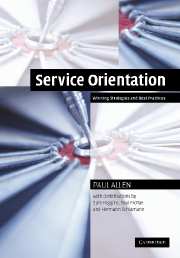
    Companies face major challenges as they seek to flourish in competitive global markets, fuelled by developments in technology, from the Internet to grid computing and Web services. In this environment, service orientation - aligning business processes to the changing demands of customers - is emerging as a highly effective approach to increasing efficiency. In this book, Paul Allen provides an accessible guide to service orientation, showing how it works and highlighting the benefits it can deliver. The book provides an integrated approach: after covering the basics of service orientation, he discusses key issues such as business agility, designing quality-of-service infrastructure, implementing service-level agreements, and cultural factors. He provides roadmaps, definitions, templates, techniques, process patterns and checklists to help you realize service orientation. These resources are reinforced with detailed case studies, from the transport and banking sectors. Packed with valuable insights, the book will be essential reading for CIOs, IT architects and senior developers. IT facing business executives will also benefit from understanding how software services can enable their business strategies.Paul Allen is a principal business-IT strategist at CA and is widely recognized for his innovative work in component-based development (CBD), business-IT alignment and service-oriented architecture. With over thirty years experience of large-scale business systems, he is an established author whose previous book was the critically acclaimed Realizing e-Business with Components.Sam Higgins is now with Forrester Research Inc.; formerly he managed the Innovation and Planning Unit of Queensland Transport's Information Services Branch.Paul McRae is the application architect in the Innovation and Planning Unit of Queensland Transport's Information Services Branch.Hermann Schlamann is a senior architect in the architecture group of Credit Suisse.

    Reviews

    'For the last 40 years, business has viewed IT as its principal tool to increase productivity, and rightly so. Industries as diverse as retailing and financial services have been transformed by technology, especially when used in a networked way. Yet very often, IT has constrained the evolution of those business processes by imposing rigid technology implementations on them. And even worse, as IT has grown and become more important, it has become more complex and difficult to manage, especially in larger enterprises. In some cases the sheer complexity of the IT environment has started to limit the ability of companies to innovate. However, as Paul Allen shows, recent advances in IT processes and technologies, especially service-oriented architectures are starting to free companies up from these constraints, and allow them to once again align their IT processes in support of their business processes. Service Orientation: Winning Strategies and Best Practices charts the course for handling what promises to be as profound a change to IT as any that has occurred in the last few decades.'

    John A Swainson - President and CEO, CA

    Refine List

    Actions for selected content:

    Select all | Deselect all
    • View selected items
    • Export citations
    • Download PDF (zip)
    • Save to Kindle
    • Save to Dropbox
    • Save to Google Drive

    Save Search

    You can save your searches here and later view and run them again in "My saved searches".

    Please provide a title, maximum of 40 characters.
    ×

    Contents

    References
    References
    Ahern, D. M., Clouse, A., and Turner, R. (2003), Capability Maturity Model® Integration Distilled: A Practical Introduction to Integrated Process Improvement, 2nd edn., Addison-Wesley
    Allen, P. (2000), Realizing e-Business with Components, Addison-Wesley Longman
    Allen, P. (2001a), Light Methodologies and component-based development, Component Development Strategies, 11 (4)
    Allen, P. (2001b), Heavy Methodologies and component-based development, Component Development Strategies, 11 (5)
    Allen, P. (2002), Component Quality: The Great Debate, Component Development Strategies, 12 (3)
    Allen, P. and Frost, S. (1998), Component-Based Development for Enterprise Systems: Applying the SELECT Perspective, Cambridge University Press/SIGS Publications
    American Productivity and Quality Centre (1996), Process Classification Framework, American Productivity and Quality Centre International Clearing House
    Austin, R. and Devin, L. (2003), Artful Making: What Managers Need to Know About How Artists Work, Financial Times Prentice Hall
    Bass, L., Clements, P., and Kazman, K. (2003), Software Architecture in Practice, 2nd edn., Pearson Education
    Beck, K. (2000), Extreme Programming Explained, Addison-Wesley Longman
    Best, J. (2003), Half of All Outsourcing Deals Failing, Silicon.Com, November 21, http://management.silicon.com/itdirector/0,39024673,39117009,00.htm
    Cambray, D. and Hodgkiss, G. (2003), information technology Security Management, Version 1.0, itSMF Ltd
    Carr, N. (2003), information technology Doesn't Matter, Harvard Business Review, May, 41–9
    Cash, J., McFarlan, W. and McKenney, J. (1992), Corporate Information Systems Management: The Issues Facing Senior Executives, Richard D Irwin
    Cheesman, J. and Daniels, J. (2000), Component Modeling with Unified Modeling Language, Addison-Wesley
    Chisholm, M. (2003), How to Build a Business Rules Engine: Extending Application Functionality through Metadata Engineering, Morgan Kaufmann
    Chrissis, M. B., Konrad, M., and Shrum, S. (2003), Capability Maturity Model® Integration: Guidelines for Process Integration and Product Improvement, Addison-Wesley
    Coplien, J. (2004), Back to the Source: Putting the Business Back in OOD, Cutter information technology Journal, 17(1), 5–11
    DeMarco, T. (1982), Controlling Software Projects, Prentice Hall (Yourdon Press)
    DeMarco, T. and Lister, T. (2003), Waltzing with Bears: Managing Risk on Software Projects, Dorset House
    Dodd, J. (2004), Web Services: Time Off for Good Behavior, Cutter information technology Journal, 17(5), 22–30
    Erl, T. (2004), Service-Oriented Architecture: A Field Guide to Integrating extended mark-up language and Web Services, Prentice Hall
    Finkelstern, C. (1989), Information Engineering: Basic Principles, Addison-Wesley Longman
    Foreman, J. (1996), Product Line Based Software Development – Significant Results, Future Challenges, Proceedings of the Fifth International Conference on Software Quality, Salt Lake City, April 23
    Gamma, E., Helm, R., Johnson, R., and Vlissides, J. (1995), Design Patterns: Elements of Reusable Object-Oriented Software, Addison-Wesley
    Gilb, T. (1988), Principles of Software Engineering Management, Addison-Wesley
    Haeckel, S. H. (1999), Adaptive Enterprise: Creating and Leading Sense-and-Respond Organizations, Harvard Business School Press
    Hammer, M. and Champy, J. (1993), Reengineering the Corporation: A Manifesto for Business Revolution, Allen & Unwin
    Harmon, P. (2003), Business Process Change: A Manager's Guide, Morgan Kaufmann
    Hughes, J., Bader, J., and Corrigan, P. (2004), Characteristics of Service-Based Infrastructure and the Role of Utility Computing, Cutter information technology Journal, 17(5), 37–43
    JISC infoNet, responsibility, authority, expertise, work Analysis (2004), Information Kit Notes, Northumbria University; http://www.jiscinfonet.ac.uk/InfoKits/process-review/process-review-9.7
    Kalakota, R. and Robinson, M. (2003), Services Blueprint, Addison-Wesley Longman
    Kaplan, J. (2005), Backsourcing: Why, When, and How to Do It, Cutter Sourcing and Vendor Relationships Advisory Service, 6(1)
    Kaplan, R. S. and Norton, D. P. (1996), Using the Balanced Scorecard as a Strategic Management System, Harvard Business Review, January–February, 75–85
    Kaye, D. (2003), Loosely Coupled: The Missing Pieces of Web Services, RDS Press
    Kiepuszewski, B., Paluskiewicz, M., and Stokalski, B. (2004), Service-Oriented Architecture Applied, Cutter information technology Journal, 17(5), 14–21
    Longworth, D. (2004), Web Services Quicken Pace of Queensland's service-oriented architecture, Loosely Coupled Monthly Digest, September, 8–9, http://www.looselycoupled.com/pubs/digest
    Luckham, D. (2002), The Power of Events: An Introduction to Complex Event Processing in Distributed Enterprise Systems, Addison-Wesley Longman
    Lycett, M. (2001), Understanding Variation in component-based development: Case Findings from Practice, Information and Software Technology, 43(3), 203–13
    Macfarlane, I. and Rudd, C. (2003), information technology Service Management, Version 2.1b, itSMF Ltd
    Martin, J. Gaall (1951), Information Engineering: Basic Principles Book 1, Prentice Hall PTR
    Meyer, B. (1997), Object-Oriented Software Construction, 2nd edn., Prentice Hall
    Morgan, T. (2002), Business Rules and Information Systems: Aligning information technology with Business Goals, Addison-Wesley
    Murer, S. (2004), Credit Suisse information technology Architecture Swiss Banking information technology Platform – An Overview information technology Architecture, Concept CO_0058, Credit Suisse internal paper, Zurich, August
    Office of Government Commerce (Office of Government Commerce) (2000), Information Technology Infrastructure Library Service Support (CD-ROM), version 2.2 (0-11-330867-1)
    Office of Government Commerce (2001), Information Technology Infrastructure Library Service Delivery (CD-ROM), version 2.1 (0-11-330893-0)
    Office of Government Commerce (2002), Information Technology Infrastructure Library Application Management (CD-ROM), version (2.1 0-11-330904-X)
    OMG (2004), Unified Modeling Language 2.0 Superstructure FTF Convenience Document, OMG; http://www.omg.org/cgi-bin/doc?ptc/2004-10-02, October
    Rourke, O' C., Fishman, N., and Selkow, W. (2003), Enterprise Architecture Using the Zachman Framework, Course Technology
    Overton, C. (2001), On the Theory and Practice of Internet service-level agreements, Keynote Systems; http://www.keynote.com/downloads/SLA_Theory-and-Practice-060802.pdf
    Penker, M. and Eriksson, H. (2001), Business Modeling with Unified Modeling Language: Business Patterns at Work, Wiley
    Polan, M. (2002), Web Services Provisioning: Understanding and Using Web Services Hosting Technology, in IBM developerWorks, January, http://www-128.ibm.com/developerworks/webservices/library/ws-wsht-index.html
    Porter, M. (1980), Competitive Strategy, Free Press
    Prieto-Diaz, R. (1990), Domain Analysis: An Introduction, ACM SIGSoft Software Engineering Notes 15(2), 47–54
    Queensland Transport (Queensland Transport) (1997a), Technical Implications of a Changing Business Environment, report prepared by G. Smith
    Queensland Transport (1997b), Specification for Service-Oriented Architecture, report prepared by J. Gallagher and G. Smith
    Queensland Transport (1997c), Better Community Involvement and Client Service Delivery, Strategic Plan 1997–2001, section 3.7
    Robertson, B. and Sribar, V. (2002), The Adaptive Enterprise: information technology Infrastructure Strategies to Manage Change and Enable Growth, Pearson Education
    Rosenberg, J. and Remy, D. (2004), Securing Web Services with WS-Security, Sams Publishing
    Ross, R. (2003), Principles of the Business Rule Approach, Addison-Wesley
    Rummler, G. A. and Brache, A. P. (1995), Improving Performance: How to Manage the White Space on the Organisation Chart, 2nd edn. Jossey-Bass
    Schlamann, H. (2004), Service Orientation: An Evolutionary Approach, Cutter information technology Journal, 17(5), 5–13
    Schulte, R. (1996), Service Oriented Architectures, 2, Gartner Group RAS Services, April
    Schulte, R. and Natis, Y. (1996), Service Oriented Architectures, 1, Gartner Group RAS Services, April
    Schwaber, K. (2004), Agile Project Management with Scrum, Microsoft Press
    Sedighi, A. (2004), Quality-Oriented Services, Cutter information technology Journal, 17(5), 31–6
    Shaw, M. and Garlan, D. (1996), Software Architecture, Prentice Hall
    Smith, H. and Fingar, P. (2003a), information technology Doesn't Matter Business Processes Do, Meghan-Kiffer
    Smith, H. and Fingar, P. (2003b), The Third Wave of Business Process Management: Digital Six Sigma, Business Process Trends, December; http://www.bptrends.com/publicationfiles/12%2D03%20ART%20Digital%20Six%20Sigma%2DSmith%2DFingar1%2Epdf
    SOSA Team (2004), CA's Service-Oriented Solutions Approach (White Papers and Guidance in the form of Outline, Patterns, Deliverables and Techniques), CA Internal Documentation
    Sprott, D. (2004), Grand-Central and the Value Added Service Network, CBDI Journal, February, 5–11
    Stapleton, J. (1997), Dynamic Systems Development Method, Addison-Wesley Longman
    Taylor, D. (1995), Business Engineering with Object Technology, Wiley
    Treacy, M. and Wiersema, F. (1995), The Discipline of Market Leaders, HarperCollins
    Veryard, R. (2001), The Component-Based Business: Plug and Play, Springer Verlag
    Veryard, R. (2004a), Sarbanes-Oxley Drives Web Services Adoption, CBDI Journal, April, 4–13
    Veryard, R. (2004b), The service-oriented architecture Lifecycle, CBDI Journal, July–August, 16–23
    Welsh, T. (2004), Market Trends, Web Services Strategies, 3(12)
    Wilkes, L. (2004a), Establishing a Lifecycle, CBDI Journal, January, 16–22
    Wilkes, L. (2004b), Time to Board the Enterprise Service Bus?, CBDI Journal, July–August, 4–14
    Wilkes, L. (2004c), The Web Services Protocol Stack, component-based developmentiForum Reports, http://roadmap.cbdiforum.com/reports/protocols/
    Wilkinson, N. M. (1995), Using class responsibility collaborator Cards: An Informal Approach to Object Oriented Development, SIGS Books
    Williams, S. (2002), The Associative Model of Data, 2nd edn., Lazy Software Ltd

    Metrics

    Full text views

    Total number of HTML views: 0
    Total number of PDF views: 0 *
    Loading metrics...

    Book summary page views

    Total views: 0 *
    Loading metrics...

    * Views captured on Cambridge Core between #date#. This data will be updated every 24 hours.

    Usage data cannot currently be displayed.

    Accessibility standard: Unknown

    Why this information is here

    This section outlines the accessibility features of this content - including support for screen readers, full keyboard navigation and high-contrast display options. This may not be relevant for you.

    Accessibility Information

    Accessibility compliance for the PDF of this book is currently unknown and may be updated in the future.
