Seniorland

-
Select format
-
- Publisher:
- Cambridge University Press
- Publication date:
- 04 September 2025
- 18 September 2025
- ISBN:
- 9781009608886
- 9781009608855
- 9781009608879
- Dimensions:
- (229 x 152 mm)
- Weight & Pages:
- 0.451kg, 232 Pages
- Dimensions:
- (229 x 152 mm)
- Weight & Pages:
- 0.36kg, 232 Pages
- Subjects:
- Social Psychology, Developmental Psychology, Psychology
You may already have access via personal or institutional login- Subjects:
- Social Psychology, Developmental Psychology, Psychology
Show more authors 
You may already have access via personal or institutional login
Book description
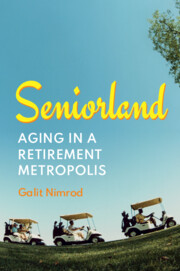
Despite the abundance of retirement communities in the US, none compare to The Villages in Central Florida. Home to nearly 150,000 residents and spanning an area larger than Manhattan, it is the world's largest retirement community and the only one that can be considered a city for older adults. Based on in-depth interviews with 40 residents and two months of participant observations, this captivating and insightful book delves into the aging experience in The Villages. It explores why people move there, their perceptions of its rapid growth, changes in their daily activities upon moving and over time, social involvement and leisure constraints, and their sense of identity and community. In doing so, this book unveils how The Villages' unique characteristics profoundly impact residents' well-being and offers a glance into the future of old age.
Reviews
‘Dr. Nimrod provides an effective and detailed description of the complexity of aging in place, the importance of addressing effects of aging in a retirement metropolis, the problem of ageism, and limitations with leisure-oriented retirement communities given equity challenges created by catering to people with substantial wealth.’
John Dattilo - Professor Emeritus, Penn State University, USA, and author of Leisure Education Program Planning
‘This uniquely personal and academic exploration of the world’s largest retirement community challenges preconceptions and asks important questions about finding new meaning, fulfilment and fun as we age.’
Celia Dodd - author of Not Fade Away: How to Thrive in Retirement
‘Galit Nimrod eloquently triangulates theoretical, applied, and empirical evidence from 40 in-depth interviews with a wide variety of residents of the villages in central Florida to articulate both the advantages and difficulties faced by mature individuals and couples relocating to a truly unique ‘Seniorland’ retirement metropolis of 150,000+ residents.’
Kenneth S. Shultz - author of Happy Retirement: The Psychology of Reinvention
‘Seniorland offers a rare window into what daily life looks and feels like inside an age-segregated retirement metropolis. Drawing on in-depth interviews and her own observations, Galit Nimrod brings nuance to an often idealised or dismissed model of later-life living. A valuable resource for professionals working in ageing, housing, wellbeing, or life design beyond midlife.’
Denise Taylor - author of Rethinking Retirement for Positive Ageing
Contents
Contents
References
Metrics
Altmetric attention score
Full text views
Full text views helpTotal number of HTML views: 0
Total number of PDF views: 0 *
 Loading metrics...
* Views captured on Cambridge Core between #date#. This data will be updated every 24 hours.
Usage data cannot currently be displayed.
Accessibility standard: Missing or limited accessibility features
Why this information is here
This section outlines the accessibility features of this content - including support for screen readers, full keyboard navigation and high-contrast display options. This may not be relevant for you.
Accessibility Information
The PDF of this book is known to have missing or limited accessibility features. We may be reviewing its accessibility for future improvement, but final compliance is not yet assured and may be subject to legal exceptions. If you have any questions, please contact accessibility@cambridge.org.
Content Navigation
Table of contents navigation
Allows you to navigate directly to chapters, sections, or non‐text items through a linked table of contents, reducing the need for extensive scrolling.
Index navigation
Provides an interactive index, letting you go straight to where a term or subject appears in the text without manual searching.
Reading Order and Textual Equivalents
Single logical reading order
You will encounter all content (including footnotes, captions, etc.) in a clear, sequential flow, making it easier to follow with assistive tools like screen readers.
Short alternative textual descriptions
You get concise descriptions (for images, charts, or media clips), ensuring you do not miss crucial information when visual or audio elements are not accessible.
Full alternative textual descriptions
You get more than just short alt text: you have comprehensive text equivalents, transcripts, captions, or audio descriptions for substantial non‐text content, which is especially helpful for complex visuals or multimedia.
Visual Accessibility
Use of colour is not sole means of conveying information
You will still understand key ideas or prompts without relying solely on colour, which is especially helpful if you have colour vision deficiencies.
Use of high contrast between text and background colour
You benefit from high‐contrast text, which improves legibility if you have low vision or if you are reading in less‐than‐ideal lighting conditions.