
Skip to main content Accessibility help
×
  • Cited by 23
    • Show more authors
    • You may already have access via personal or institutional login
    • Select format
    • Publisher:
      Cambridge University Press
      Publication date:
      September 2022
      September 2022
      ISBN:
      9781009025515
      9781316516935
      9781009016445
      Dimensions:
      (229 x 152 mm)
      Weight & Pages:
      0.59kg, 308 Pages
      Dimensions:
      (229 x 152 mm)
      Weight & Pages:
      0.46kg, 308 Pages
    You may already have access via personal or institutional login
  • Selected: Digital
    Add to cart View cart Buy from Cambridge.org

    Book description

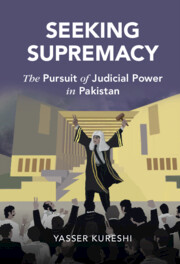
    The emergence of the judiciary as an assertive and confrontational center of power has been the most consequential new feature of Pakistan's political system. This book maps out the evolution of the relationship between the judiciary and military in Pakistan, explaining why Pakistan's high courts shifted from loyal deference to the military to open competition, and confrontation, with military and civilian institutions. Yasser Kureshi demonstrates that a shift in the audiences shaping judicial preferences explains the emergence of the judiciary as an assertive power center. As the judiciary gradually embraced less deferential institutional preferences, a shift in judicial preferences took place and the judiciary sought to play a more expansive and authoritative political role. Using this audience-based approach, Kureshi roots the judiciary in its political, social and institutional context, and develops a generalizable framework that can explain variation and change in judicial-military relations around the world.

    Awards

    Short-listed, 2024 Bloomsbury Pakistan Book Prize, Social Science and Research Advocacy

    Reviews

    ‘Seeking Supremacy is a model for research on comparative judicial politics. Kureshi leverages deep contextual knowledge of the Pakistani case to develop powerful theoretical insights that travel well beyond South Asia. There is much to learn from and admire in this most impressive book.'

    Tamir Moustafa - Professor and Stephen Jarislowsky Chair, Director, School for International Studies, Simon Fraser University, Canada

    'In this path-breaking study of law and politics in South Asia, Yasser Kureshi argues that judges care about their reputations. But, more importantly, he notes that reputations are tied to shifting ‘audiences’. With a painstaking eye for socio-legal details, Kureshi shows how senior judges focused on Pakistan’s military and bureaucratic elite gave way to those focused on highly politicised bar councils. This shift to civilian circles, however, does not imply a shift in favour of democracy. Kureshi's account of judicial politics in Pakistan also unpacks emerging forms of judicial populism in other parts of the world.'

    Matthew J. Nelson - Professor of Politics, SOAS University of London

    ‘This sophisticated study not only helps us understand the central institutions of modern Pakistan, but it also provides a model for how to analyze judicial politics as they unfold over time. Focusing on the understudied dynamics of military-judicial relations, Kureshi braids multiple streams of evidence into a richly textured study that will be useful for comparative scholars in many regions.’

    Tom Ginsburg - Leo Spitz Distinguished Service Professor of International Law, Ludwig and Hilde Wolf Research Scholar, Professor of Political Science, University of Chicago

    ‘Seeking Supremacy is an impressive contribution to our understanding of courts within political regimes. Skillfully applying the concept of judicial audiences to a rich body of evidence, Yasser Kureshi provides a persuasive account of the movement of Pakistan’s courts toward a more independent and assertive role.’

    Lawrence Baum - Professor Emeritus of Political Science, Ohio State University

    ‘A superb study of the construction of judicial power in Pakistan, Seeking Supremacy shines a bright light on a crucial question in constitutional politics: how does a court consolidate power? Yasser Kureshi blends in-depth interviews, archival research, constitutional comparisons, and doctrinal analysis in this beautifully written model for socio-legal inquiry. Strongly recommended!’

    Richard Albert - Professor of World Constitutions and Director of Constitutional Studies, The University of Texas at Austin

    Refine List

    Actions for selected content:

    Select all | Deselect all
    • View selected items
    • Export citations
    • Download PDF (zip)
    • Save to Kindle
    • Save to Dropbox
    • Save to Google Drive

    Save Search

    You can save your searches here and later view and run them again in "My saved searches".

    Please provide a title, maximum of 40 characters.
    ×

    Contents

    Metrics

    Altmetric attention score

    Full text views

    Total number of HTML views: 0
    Total number of PDF views: 0 *
    Loading metrics...

    Book summary page views

    Total views: 0 *
    Loading metrics...

    * Views captured on Cambridge Core between #date#. This data will be updated every 24 hours.

    Usage data cannot currently be displayed.

    Accessibility standard: Unknown

    Why this information is here

    This section outlines the accessibility features of this content - including support for screen readers, full keyboard navigation and high-contrast display options. This may not be relevant for you.

    Accessibility Information

    Accessibility compliance for the PDF of this book is currently unknown and may be updated in the future.
