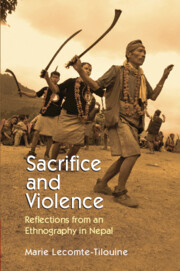
Sacrifice and Violence

-
Select format
-
- Publisher:
- Cambridge University Press
- Publication date:
- 28 November 2024
- 20 February 2025
- ISBN:
- 9781009537476
- 9781009537490
- Dimensions:
- (228 x 152 mm)
- Weight & Pages:
- 0.56kg, 280 Pages
- Dimensions:
- Weight & Pages:
You may already have access via personal or institutional login
Show more authors 
You may already have access via personal or institutional login
Book description
Violence is at the heart of the sacrifice, despite its denial in the texts. For the participants and observers, it materialises in the exposure of everyone and everything to the 'fountains of blood'. The specificity of this public and holistic violence, orchestrated in Nepal by the highest dignitaries and aimed at the rejuvenation of the cosmic, political and social order, allows us to see sacrifice as the ultimate model of legitimate violence. At the same time, observation reveals its oxymoronic nature through the opposite effect its violence has on its participants. As such, sacrifice is not only the organiser of society, but also the revelator of its internal tensions and fault lines. The book explores the complex aspects of royal ceremonies, their contestation by different groups, and finally the contours of the new legitimacy that sacrifice found during the revolutionary period under its most extreme form of human sacrifice.
Contents
Contents
Metrics
Full text views
Full text views helpTotal number of HTML views: 0
Total number of PDF views: 0 *
 Loading metrics...
* Views captured on Cambridge Core between #date#. This data will be updated every 24 hours.
Usage data cannot currently be displayed.
Accessibility standard: Unknown
Why this information is here
This section outlines the accessibility features of this content - including support for screen readers, full keyboard navigation and high-contrast display options. This may not be relevant for you.
Accessibility Information
Accessibility compliance for the PDF of this book is currently unknown and may be updated in the future.