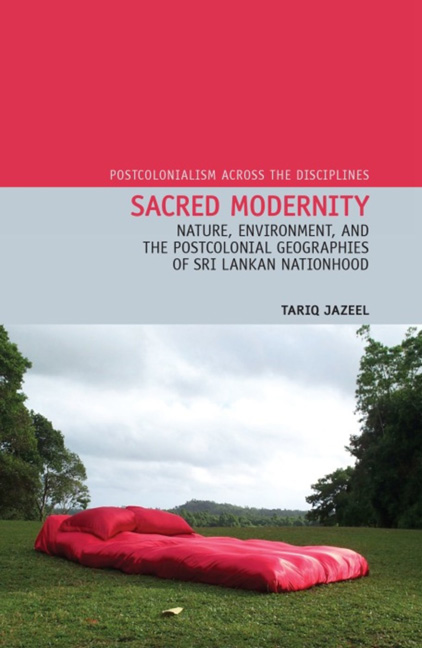
Sacred Modernity

-
The digital format of this book is no longer available to purchase from Cambridge Core. Other formats may be available.
-
Select format
-
- Publisher:
- Liverpool University Press
- Publication date:
- 17 June 2017
- 31 December 2013
- ISBN:
- 9781781388303
- 9781846318863
- Dimensions:
- Weight & Pages:
- Dimensions:
- Weight & Pages:
- Subjects:
- Human Geography, Geography
You may already have access via personal or institutional login- Subjects:
- Human Geography, Geography
Show more authors 
You may already have access via personal or institutional login
Book description
Sacred Modernity argues how everyday non-secular experiences of the natural world in Sri Lanka perpetuate ethno-religious identitarian narratives. It demonstrates the relationships between spaces of nature and environment and an ongoing aesthetic and spatial constitution of power and the political in which Theravada Buddhism is centrally implicated. To do this, the book works consecutively through two in-depth case studies, both of which are prominent sites through which Sri Lankan nature and environment are commodified: first, the country’s most famous national park, Ruhuna (Yala), and second, its post-1950s modernist environmental architecture, ‘tropical modernism’. By engaging these sites, the book reveals how commonplace historical understandings as well as commonplace material negotiations of the seductions of Sri Lankan nature are never far from the continued production of a post-independent national identity marked ethnically as Sinhalese and religiously as Buddhist. In the Sri Lankan context this minoritizes Tamil, Muslim and Christian non-Sinhala difference in the nation-state's natural, environmental and historical order of things.To make this argument, the book writes against the grain of Eurocentric social scientific understandings of the concepts 'nature' and 'religion'. It argues that these concepts and their implicit binary mobilizations of nature/culture and the sacred/secular respectively, struggle to make visible the pervasive ways that Buddhism – thought instead as a ‘structure of feeling’ or aesthetics – simultaneously naturalizes and ethnicizes the fabric of the national in contemporary Sri Lanka.Sacred Modernity shows the care and postcolonial methodological sensitivity required to understand how ‘nature’ and ‘religion’ might be thought through non-EuroAmerican field contexts, especially those in South Asia.
Contents
Contents
Metrics
Altmetric attention score
Full text views
Full text views helpTotal number of HTML views: 0
Total number of PDF views: 0 *
 Loading metrics...
* Views captured on Cambridge Core between #date#. This data will be updated every 24 hours.
Usage data cannot currently be displayed.
Accessibility standard: Unknown
Why this information is here
This section outlines the accessibility features of this content - including support for screen readers, full keyboard navigation and high-contrast display options. This may not be relevant for you.
Accessibility Information
Accessibility compliance for the PDF of this book is currently unknown and may be updated in the future.