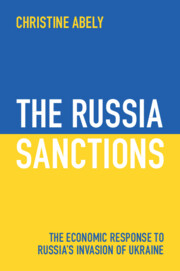

In The Russia Sanctions, Christine Abely examines the international trade measures and sanctions deployed against Russia in response to its 2022 invasion of Ukraine. Abely situates contemporary sanctions within their larger historical and economic backgrounds and provides a uniquely accessible analysis of the historic export controls and import restrictions enacted since 2022. She argues that these sanctions have affected, and will continue to affect, global trading patterns, financial integration, and foreign policy in novel ways. In particular, she examines the effects of sanctions on energy, food, fertilizer, the financial system, and the global use of the US dollar, including trends of de-dollarization. Coverage includes sanctions against oligarchs, the freezing and seizure of assets, and steps taken to make sanctions more effective by promoting financial transparency worldwide.
‘The US, UK, EU, Japan, and other allies imposed quick and coordinated sanctions on Russia following Putin’s invasion of Ukraine in 2022. Christine Abely wields her legal expertise to tell the fast-paced story of how, due to a complex and interdependent global economy, even these far-reaching sanctions were nevertheless not enough.’
Chad P. Bown - Reginald Jones Senior Fellow, Peterson Institute for International Economics
‘Christine Abely has pulled off an impressive feat: a comprehensive guide to the 2022 sanctions against Russia. In crisp and clear prose, Abely brings order to the complexity of the most consequential sanctions in modern history. The Russia Sanctions is an invaluable resource for scholars, students, and practitioners alike.’
Edward Fishman - Senior Research Scholar, Columbia University Center on Global Energy Policy; former Russia and Europe Sanctions Lead, US Department of State
'An excellent overview.'
Max Harris Source: Times Literary Supplement
‘… an excellent reference, offering a succinct overview of the history of U.S. and European sanctions and a concise guide to the relevant legislation from several jurisdictions.’
J. Benton Heath Source: American Journal of International Law
Loading metrics...
* Views captured on Cambridge Core between #date#. This data will be updated every 24 hours.
Usage data cannot currently be displayed.
This section outlines the accessibility features of this content - including support for screen readers, full keyboard navigation and high-contrast display options. This may not be relevant for you.
Accessibility compliance for the PDF of this book is currently unknown and may be updated in the future.
