
Skip to main content Accessibility help
×
  • Cited by 63
    • Show more authors
    • You may already have access via personal or institutional login
    • Select format
    • Publisher:
      Cambridge University Press
      Publication date:
      September 2018
      August 2018
      ISBN:
      9781139424721
      9781107032187
      9781107698604
      Dimensions:
      (228 x 152 mm)
      Weight & Pages:
      0.51kg, 240 Pages
      Dimensions:
      (228 x 152 mm)
      Weight & Pages:
      0.41kg, 240 Pages
    You may already have access via personal or institutional login
  • Selected: Digital
    Add to cart View cart Buy from Cambridge.org

    Book description

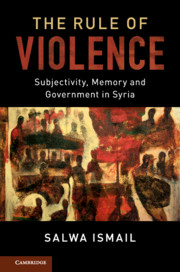
    Over much of its rule, the regime of Hafez al-Asad and his successor Bashar al-Asad deployed violence on a massive scale to maintain its grip on political power. In this book, Salwa Ismail examines the rationalities and mechanisms of governing through violence. In a detailed and compelling account, Ismail shows how the political prison and the massacre, in particular, developed as apparatuses of government, shaping Syrians' political subjectivities, defining their understanding of the terms of rule and structuring their relations and interactions with the regime and with one another. Examining ordinary citizens' everyday life experiences and memories of violence across diverse sites, from the internment camp and the massacre to the family and school, The Rule of Violence demonstrates how practices of violence, both in their routine and spectacular forms, fashioned Syrians' affective life, inciting in them feelings of humiliation and abjection, and infusing their lived environment with dread and horror. This form of rule is revealed to be constraining of citizens' political engagement, while also demanding of their action.

    Reviews

    'In this highly original, but also deeply disturbing book Salwa Ismail has captured superbly the daily and the spectacular acts of violence that have marked Ba`thist rule in Syria. The cumulative effects of dread, fear and horror on the Syrian subject, conformist as well as resistant, are at the centre of this account, giving a unique insight into the conditions that have torn the country apart.'

    Charles Tripp - School of Oriental and African Studies, University of London

    'The Rule of Violence offers a sophisticated, innovative and powerful examination of the manifold ways in which violence shaped modern Syria. Ismail's theoretically engaged and richly informed narrative traces the deep impact on Syria's citizens of state violence, from the intimate horrors of prison torture and the mass atrocities of the 1982 devastation of Hama to the brutal wars following the uprising of 2011. Ranging from politics and war to literature and popular culture, it stands as a critical contribution to our understanding of the deep legacies of authoritarian state violence.'

    Marc Lynch - The George Washington University, and author of The New Arab Wars:  Anarchy and Uprising in the Middle East

    'This is a masterful account of how ‘horror’ came to be a central mode of governance in Syria under the Asad regime. Salwa Ismail’s skilful scholarship expands our understanding of state violence through shifting focus to its affective dimensions in both the spectacular and the everyday. This is a powerful and utterly compelling book, a must read for students of Syria and authoritarianism.'

    Michelle Obeid - University of Manchester

    ‘This book … is essential … to a study of what has been happening in the Middle East in recent decades.’

    Matthieu Rey Source: Cairn

    Refine List

    Actions for selected content:

    Select all | Deselect all
    • View selected items
    • Export citations
    • Download PDF (zip)
    • Save to Kindle
    • Save to Dropbox
    • Save to Google Drive

    Save Search

    You can save your searches here and later view and run them again in "My saved searches".

    Please provide a title, maximum of 40 characters.
    ×

    Contents

    Metrics

    Altmetric attention score

    Full text views

    Total number of HTML views: 0
    Total number of PDF views: 0 *
    Loading metrics...

    Book summary page views

    Total views: 0 *
    Loading metrics...

    * Views captured on Cambridge Core between #date#. This data will be updated every 24 hours.

    Usage data cannot currently be displayed.

    Accessibility standard: Unknown

    Why this information is here

    This section outlines the accessibility features of this content - including support for screen readers, full keyboard navigation and high-contrast display options. This may not be relevant for you.

    Accessibility Information

    Accessibility compliance for the PDF of this book is currently unknown and may be updated in the future.
