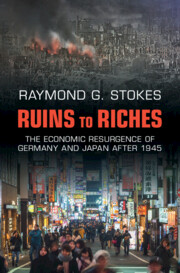
Ruins to Riches

-
Select format
-
- Publisher:
- Cambridge University Press
- Publication date:
- April 2024
- May 2024
- ISBN:
- 9781009083669
- 9781316514528
- Dimensions:
- (229 x 152 mm)
- Weight & Pages:
- 0.64kg, 345 Pages
- Dimensions:
- Weight & Pages:
You may already have access via personal or institutional login
Show more authors 
You may already have access via personal or institutional login
Book description
In 1945, Germany and Japan lay prostrate after total war and resounding defeat. By 1960, they had the second and fifth largest economies in the world respectively. This global leadership has been maintained ever since. How did these 'economic miracles' come to pass, and why were these two nations particularly adept at achieving them? Ray Stokes is the first to unpack these questions from comparative and international perspectives, emphasising both the individuals and companies behind this exceptional performance and the broader global political and economic contexts. He highlights the potent mixtures in both countries of judicious state action, effective industrial organisation, benign labour relations, and technological innovation, which they adapted constantly – sometimes painfully – to take full advantage of rapidly growing post-war international trade and globalisation. Together, they explain the spectacular resurgence of Deutschland AG and Japan Incorporated to global economic and technological leadership, which they have sustained to the present.
Reviews
‘Stokes provides a highly accessible and nuanced comparative history of the evolution of German and Japanese capitalism after World War II, highlighting the key if ambiguous role of the United States in their success.’
Geoffrey Jones - author of Deeply Responsible Business. A Global History of Values-Driven Leadership
‘Ray Stokes presents a marvelous synthetic history of the remarkable (and as he shows, somewhat surprising) post World War II recovery and growth of the German and Japanese economies. The book is an excellent resource for anyone wanting to understand the remarkable and enduring success of both of these highly successful political economies.’
Gary Herrigel - author of Manufacturing Constructions: Creative Action and Industrial Recomposition in the US, Germany and Japan
‘Ray Stokes is one of the foremost international experts on the history of German industrialization and now he has turned his historical acumen to Japan as well. The result is extraordinarily good, filled with fresh insights and fascinating details. We have needed a work like this for a long time, and Stokes has provided it with masterful style and verve.’
Mark Metzler - author of Capital as Will and Imagination: Schumpeter’s Guide to the Postwar Japanese Miracle
‘Writing with clarity and force, Ray Stokes tells one of the most important economic stories in modern history. The economic recovery of Japan and Germany after World War II, when in a few decades they transformed from defeated nations with devastated infrastructures into economic powerhouses with the second and third largest economies in the world, remains a stunning development. This is an important book both to understand the past and think towards the future, and Stokes should be commended for writing it.’
Phillips O’Brien - author of How the War Was Won: Air-Sea Power and Allied Victory in World War II
‘This is a well-researched and well-structured book that makes a valuable contribution to the field of comparative economic history. It will be of great interest to economic and business historians seeking a better understanding of the similarities and differences among the economic models and histories of Germany, Japan, and the United States. Its clear structure and coverage of many essential issues also make it an excellent read for advanced undergraduate and graduate students in economic and business history.’
Jonathan Krautter Source: H-Soz-Kult
Contents
References
Metrics
Altmetric attention score
Full text views
Full text views helpTotal number of HTML views: 0
Total number of PDF views: 0 *
 Loading metrics...
* Views captured on Cambridge Core between #date#. This data will be updated every 24 hours.
Usage data cannot currently be displayed.
Accessibility standard: Unknown
Why this information is here
This section outlines the accessibility features of this content - including support for screen readers, full keyboard navigation and high-contrast display options. This may not be relevant for you.
Accessibility Information
Accessibility compliance for the PDF of this book is currently unknown and may be updated in the future.