
Skip to main content Accessibility help
×
  • Cited by 161
    • Show more authors
    • You may already have access via personal or institutional login
    • Select format
    • Publisher:
      Cambridge University Press
      Publication date:
      22 September 2009
      11 January 2001
      ISBN:
      9780511490583
      9780521792653
      9780521025492
      Dimensions:
      (228 x 152 mm)
      Weight & Pages:
      0.816kg, 426 Pages
      Dimensions:
      (228 x 152 mm)
      Weight & Pages:
      0.648kg, 428 Pages
    You may already have access via personal or institutional login
  • Selected: Digital
    Add to cart View cart Buy from Cambridge.org

    Book description

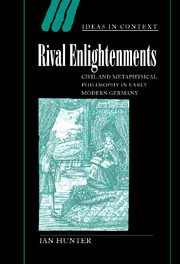
    Rival Enlightenments, first published in 2001, is a major reinterpretation of early modern German intellectual history. Ian Hunter approaches philosophical doctrines as ways of fashioning personae for envisaged historical circumstances, here of confessional conflict and political desacralization. He treats the civil philosophy of Pufendorf and Thomasius and the metaphysical philosophy of Leibniz and Kant as rival intellectual cultures or paideiai, thereby challenging all histories premised on Kant's supposed reconciliation and transcendence of the field. This study reveals the extraordinary historical self-consciousness of the civil philosophers, who repudiated university metaphysics as inimical to the intellectual formation of those administering desacralized territorial states. The book argues that the marginalization of civil philosophy in post-Kantian philosophical history may itself be seen as a continuation of the struggle between the rival enlightenments. Combining careful and well-documented scholarship with vivid polemic, Hunter presents penetrating insights for philosophers and historians alike.

    Reviews

    ‘This fresh assessment helps us see that Kant re-spiritualized morality and citizenship, as well as the state, although in an abstract and appealing ‘modern way’.’

    Thomas Robisheaux - Duke University

    ‘… we should thank Hunter for a provocative and valuable book …’

    Source: Theory and Event online version

    ‘… by the end of the book you'll never again be able to look your students in the eye and utter the word ‘the enlightenment’ in the singular. You will likely think long and hard about leaving Pufendorf, and perhaps even Thomasius, off any political philosophy reading list that includes Rousseau and Kant. You will leave convinced that political and moral concerns played central roles in shaping early modern philosophy.’

    Source: Theory and Event

    ‘By this complex and fascinating structure of philosophical and historical argument. Hunter hopes to free his readers from captivity to the dominant Kantian picture of Enlightenment and modernity … This ambitious historical project is pursued through the interpretation of a wide range of major and minor primary texts over two centuries … This is an invaluable study for anyone interested in the Enlightenment and its continuing influence. In virtue of its scholarship and refreshingly provocative theses it should be at the centre of any debate over ‘What is Enlightenment?’.’

    Source: Economy and Society

    ‘… a work of outstanding scholarship and originality …’

    Source: Economy and Society

    ‘… a book Kant scholars should definitively take notice of. Based on intensive historical analysis, Hunter rejects the common notion that the German enlightenment found its high point in Kant. He does so in favour of a reconsideration of authors such as Pufendorf and Thomasius.’

    Source: Kantian Review

    Refine List

    Actions for selected content:

    Select all | Deselect all
    • View selected items
    • Export citations
    • Download PDF (zip)
    • Save to Kindle
    • Save to Dropbox
    • Save to Google Drive

    Save Search

    You can save your searches here and later view and run them again in "My saved searches".

    Please provide a title, maximum of 40 characters.
    ×

    Contents

    Metrics

    Altmetric attention score

    Full text views

    Total number of HTML views: 0
    Total number of PDF views: 0 *
    Loading metrics...

    Book summary page views

    Total views: 0 *
    Loading metrics...

    * Views captured on Cambridge Core between #date#. This data will be updated every 24 hours.

    Usage data cannot currently be displayed.

    Accessibility standard: Unknown

    Why this information is here

    This section outlines the accessibility features of this content - including support for screen readers, full keyboard navigation and high-contrast display options. This may not be relevant for you.

    Accessibility Information

    Accessibility compliance for the PDF of this book is currently unknown and may be updated in the future.
