
Skip to main content Accessibility help
×
  • Cited by 4
    • The digital format of this book is no longer available to purchase from Cambridge Core. Other formats may be available.
    • Show more authors
    • You may already have access via personal or institutional login
    • Select format
    • Publisher:
      Mathematical Association of America
      Publication date:
      26 May 2017
      01 March 2016
      ISBN:
      9780883859896
      9780883856505
      Dimensions:
      Weight & Pages:
      Dimensions:
      Weight & Pages:
    You may already have access via personal or institutional login
    Selected: Digital
    Add to cart View cart Buy from Cambridge.org

    Book description

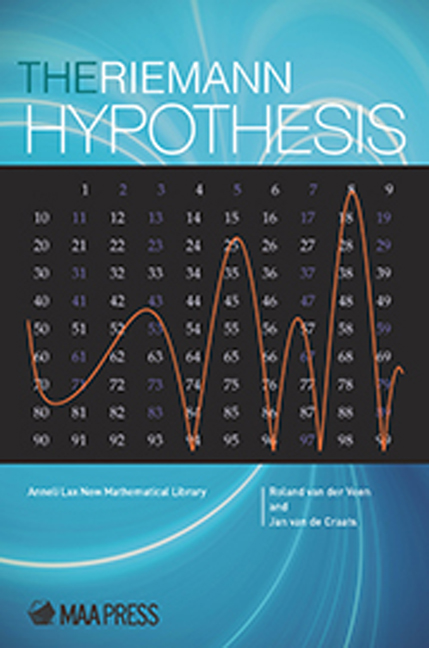
    The Riemann hypothesis concerns the prime numbers 2, 3, 5, 7, 11, 13, 17, 19, 23, 29, 31, 37, 41, 43, 47 ...Ubiquitous and fundamental in mathematics as they are, it is important and interesting to know as much as possible about these numbers. Simple questions would be: how are the prime numbers distributed among the positive integers? What is the number of prime numbers of 100 digits? Of 1,000 digits? These questions were the starting point of a groundbreaking paper by Bernhard Riemann written in 1859. As an aside in his article, Riemann formulated his now famous hypothesis that so far no one has come close to proving: All nontrivial zeroes of the zeta function lie on the critical line.

    Hidden behind this at first mysterious phrase lies a whole mathematical universe of prime numbers, infinite sequences, infinite products, and complex functions. The present book is a first exploration of this fascinating, unknown world. It originated from an online course for mathematically talented secondary school students organized by the authors of this book at the University of Amsterdam. Its aim was to bring the students into contact with challenging university level mathematics and show them what the Riemann Hypothesis is all about and why it is such an important problem in mathematics.

    Refine List

    Actions for selected content:

    Select all | Deselect all
    • View selected items
    • Export citations
    • Download PDF (zip)
    • Save to Kindle
    • Save to Dropbox
    • Save to Google Drive

    Save Search

    You can save your searches here and later view and run them again in "My saved searches".

    Please provide a title, maximum of 40 characters.
    ×

    Metrics

    Altmetric attention score

    Full text views

    Total number of HTML views: 0
    Total number of PDF views: 0 *
    Loading metrics...

    Book summary page views

    Total views: 0 *
    Loading metrics...

    * Views captured on Cambridge Core between #date#. This data will be updated every 24 hours.

    Usage data cannot currently be displayed.

    Accessibility standard: Unknown

    Why this information is here

    This section outlines the accessibility features of this content - including support for screen readers, full keyboard navigation and high-contrast display options. This may not be relevant for you.

    Accessibility Information

    Accessibility compliance for the PDF of this book is currently unknown and may be updated in the future.
