
Skip to main content Accessibility help
×
  • Cited by 1
    • The digital format of this book is no longer available to purchase from Cambridge Core. Other formats may be available.
    • Show more authors
    • You may already have access via personal or institutional login
    • Select format
    • Publisher:
      Mathematical Association of America
      Publication date:
      Invalid date
      January 2009
      ISBN:
      9780883851845
      Dimensions:
      Weight & Pages:
      Dimensions:
      Weight & Pages:
      00kg,
    You may already have access via personal or institutional login
    Selected: Digital
    Add to cart View cart Buy from Cambridge.org

    Book description

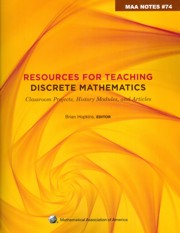
    A resource for discrete mathematics teachers at all levels. Resources for Teaching Discrete Mathematics presents nineteen classroom tested projects complete with student handouts, solutions, and notes to the instructor. Topics range from a first day activity that motivates proofs to applications of discrete mathematics to chemistry, biology, and data storage. Other projects provide: supplementary material on classic topics such as the towers of Hanoi and the Josephus problem, how to use a calculator to explore various course topics, how to employ Cuisenaire rods to examine the Fibonacci numbers and other sequences, and how you can use plastic pipes to create a geodesic dome. The book contains eleven history modules that allow students to explore topics in their original context. Sources range from eleventh century Chinese figures that prompted Leibniz to write on binary arithmetic, to a 1959 article on automata theory. Excerpts include: Pascal's 'Treatise on the Arithmetical Triangle,' Hamilton's 'Account of the Icosian Game,' and Cantor's (translated) 'Contributions to the Founding of the Theory of Transfinite Numbers.' Five articles complete the book. Three address extensions of standard discrete mathematics content: an exploration of historical counting problems with attention to discovering formulas, a discussion of how computers store graphs, and a survey connecting the principle of inclusion-exclusion to Möbius inversion. Finally, there are two articles on pedagogy specifically related to discrete mathematics courses: a summary of adapting a group discovery method to larger classes, and a discussion of using logic in encouraging students to construct proofs.

    Refine List

    Actions for selected content:

    Select all | Deselect all
    • View selected items
    • Export citations
    • Download PDF (zip)
    • Save to Kindle
    • Save to Dropbox
    • Save to Google Drive

    Save Search

    You can save your searches here and later view and run them again in "My saved searches".

    Please provide a title, maximum of 40 characters.
    ×

    Contents


    Page 1 of 2


    Page 1 of 2


    Metrics

    Full text views

    Total number of HTML views: 0
    Total number of PDF views: 0 *
    Loading metrics...

    Book summary page views

    Total views: 0 *
    Loading metrics...

    * Views captured on Cambridge Core between #date#. This data will be updated every 24 hours.

    Usage data cannot currently be displayed.

    Accessibility standard: Unknown

    Why this information is here

    This section outlines the accessibility features of this content - including support for screen readers, full keyboard navigation and high-contrast display options. This may not be relevant for you.

    Accessibility Information

    Accessibility compliance for the PDF of this book is currently unknown and may be updated in the future.
