
Skip to main content Accessibility help
×
  • Cited by 2
    • Show more authors
    • You may already have access via personal or institutional login
    • Select format
    • Publication date:
      17 June 2021
      20 October 2016
      ISBN:
      9781782048428
      9781843844365
      Dimensions:
      Weight & Pages:
      00kg,
      Dimensions:
      Weight & Pages:
    You may already have access via personal or institutional login
  • Selected: Digital
    Add to cart View cart Buy from Cambridge.org

    Book description

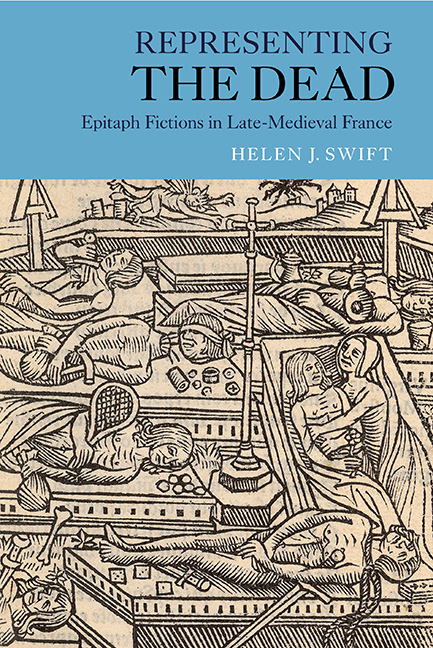
    Who am I when I am dead? Several late-medieval French writers used literary representation of the dead as a springboard for exploring the nature of human being. Death is a critical moment for identity definition: one is remembered, forgotten or, worse, misremembered. Works in prose and verse by authors from Alain Chartier to Jean Bouchet record characters' deaths, but what distinguishes them as epitaph fictions is not their commemoration of the deceased, so much as their interrogation of how, by whom, and to what purpose posthumous identity is constituted. Far from rigidly memorialising the dead, they exhibit a productive messiness in the processes by which identity is composed in the moment of its decomposition as a complex interplay between body, voice and text. The cemeteries, hospitals, temples and testaments of fifteenth- and early-sixteenth-century literature, from the "Belle Dame sans mercy" querelle to Le Jugement poetic de l'honneur femenin, present a wealth of ambulant corpses, disembodied voices, animated effigies, martyrs for love and material echoes of the past which invite readers to approach epitaphic identity as a challenging question: here lies who, exactly? In its broadest context, this study casts fresh light on ideas of selfhood in medieval culture as well as on contemporary conceptions of the capacities and purposes of literary representationitself.

    Helen Swift is Associate Professor of Medieval French at St Hilda's College, Oxford.

    Refine List

    Actions for selected content:

    Select all | Deselect all
    • View selected items
    • Export citations
    • Download PDF (zip)
    • Save to Kindle
    • Save to Dropbox
    • Save to Google Drive

    Save Search

    You can save your searches here and later view and run them again in "My saved searches".

    Please provide a title, maximum of 40 characters.
    ×

    Contents

    Metrics

    Full text views

    Total number of HTML views: 0
    Total number of PDF views: 0 *
    Loading metrics...

    Book summary page views

    Total views: 0 *
    Loading metrics...

    * Views captured on Cambridge Core between #date#. This data will be updated every 24 hours.

    Usage data cannot currently be displayed.

    Accessibility standard: Unknown

    Why this information is here

    This section outlines the accessibility features of this content - including support for screen readers, full keyboard navigation and high-contrast display options. This may not be relevant for you.

    Accessibility Information

    Accessibility compliance for the PDF of this book is currently unknown and may be updated in the future.
