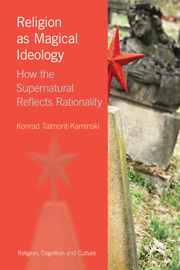
Religion as Magical Ideology

-
The digital format of this book is no longer available to purchase from Cambridge Core. Other formats may be available.
-
Select format
-
- Publisher:
- Acumen Publishing
- Publication date:
- 05 March 2014
- 30 April 2013
- ISBN:
- 9781844656455
- 9781844656448
- Dimensions:
- Weight & Pages:
- 00kg,
- Dimensions:
- Weight & Pages:
- Series:
- Religion, Cognition and Culture
- Subjects:
- Religion, Religion: General Interest
You may already have access via personal or institutional login- Series:
- Religion, Cognition and Culture
- Subjects:
- Religion, Religion: General Interest
Show more authors 
You may already have access via personal or institutional login
Book description
Religion as Magical Ideology examines the relationship between rationality and supernatural beliefs arguing that such beliefs are products of evolution, cognition and culture. The book does not offer a false rapprochement between reason and religion; instead, it explores their interrelationship as a series of complex adaptations between cognitive and cultural processes. Exploring the nature of the tension between religious traditions and reason, Religion as Magical Ideology develops a dual inheritance theory of religion - which combines the cognitive byproduct and prosocial adaptation accounts - and analyses the connection between the function of a belief and the degree of protection it gets from potential counter-evidence. With discussion ranging from individual cognitive mechanisms, general functional considerations, to the limits of evolutionary and cognitive processes, the book offers readers a systematic account of how cognition shapes religious beliefs and practices.
Reviews
"A philosophical naturalist's delight, this book - crisply written and carefully argued - weaves together insights about evolution, mind, and society to explain how religions work and how secularisation threatens them.'"
Robert N. McCauley
"Konrad Talmont-Kaminski offers a very thoughtful and thought-provoking critique of the field and an alternative approach to magic, religion, and science that should spark some debate and further research - Talmont-Kaminski has thrown down a challenge to the mainstream of anthropological thought about religion, and it is a challenge that we necessarily and gladly pick up.'"
Source: Anthropology Review Database
Contents
Contents
Metrics
Full text views
Full text views helpTotal number of HTML views: 0
Total number of PDF views: 0 *
 Loading metrics...
* Views captured on Cambridge Core between #date#. This data will be updated every 24 hours.
Usage data cannot currently be displayed.
Accessibility standard: Unknown
Why this information is here
This section outlines the accessibility features of this content - including support for screen readers, full keyboard navigation and high-contrast display options. This may not be relevant for you.
Accessibility Information
Accessibility compliance for the PDF of this book is currently unknown and may be updated in the future.