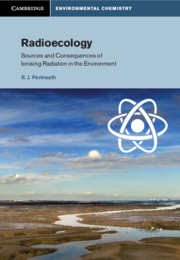
Radioecology

-
Select format
-
- Publisher:
- Cambridge University Press
- Publication date:
- 17 December 2021
- 12 August 2021
- ISBN:
- 9781316156124
- 9781107096028
- Dimensions:
- (247 x 174 mm)
- Weight & Pages:
- 0.789kg, 362 Pages
- Dimensions:
- Weight & Pages:
You may already have access via personal or institutional login
Show more authors 
You may already have access via personal or institutional login
Book description
Natural radiation arises from many sources, from the unstable atoms within our own bodies and in the materials around us, from the Sun, and even from beyond the Solar System. Additional sources include the legacy of testing nuclear weapons, nuclear waste, and nuclear accidents. All these sources have provided means of dating environmental materials and tracing the movements of substances through land, sea, and air. But ionising radiation also interacts with DNA, which has led to a remarkable range of studies to examine how and how quickly these unstable atoms are accumulated by both humans and biota, and their various effects on both. Providing an overview of the sources, uses and impacts of ionising radiation in the environment, and the frameworks developed to manage exposures to them, this is a valuable reference for graduate students and researchers interested in radioecology, environmental science and radiological protection.
Awards
Winner, 2022 Choice Outstanding Academic Titles
Reviews
‘Highly recommended.’
J. F. Burkhart Source: Choice Magazine
Contents
Contents
References
Metrics
Altmetric attention score
Full text views
Full text views helpTotal number of HTML views: 0
Total number of PDF views: 0 *
 Loading metrics...
* Views captured on Cambridge Core between #date#. This data will be updated every 24 hours.
Usage data cannot currently be displayed.
Accessibility standard: Unknown
Why this information is here
This section outlines the accessibility features of this content - including support for screen readers, full keyboard navigation and high-contrast display options. This may not be relevant for you.
Accessibility Information
Accessibility compliance for the PDF of this book is currently unknown and may be updated in the future.