
Skip to main content Accessibility help
×
  • Cited by 1
    • Show more authors
    • You may already have access via personal or institutional login
    • Select format
    • Publisher:
      Cambridge University Press
      Publication date:
      March 2023
      March 2023
      ISBN:
      9781009000611
      9781316519226
      9781009005104
      Dimensions:
      (229 x 152 mm)
      Weight & Pages:
      0.71kg, 372 Pages
      Dimensions:
      (229 x 152 mm)
      Weight & Pages:
      0.56kg, 372 Pages
    You may already have access via personal or institutional login
  • Selected: Digital
    Add to cart View cart Buy from Cambridge.org

    Book description

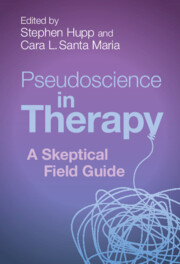
    When experiencing mental health challenges, we all deserve treatments that actually work. Whether you are a healthcare consumer, student, or mental health professional, this book will help you recognize implausible, ineffective, and even harmful therapy practices while also considering recent controversies. Research-supported interventions are identified in this book and expanded upon in a companion volume. Chapters cover every major mental disorder and are written by experts in their respective fields. Pseudoscience in Therapy is of interest to students taking courses in psychotherapy, counseling, clinical psychology, and behavior therapy, as well as practitioners looking for a guide to proven therapeutic techniques.

    Reviews

    ‘‘Psychotherapy' offers a spectrum of practices and techniques, some effective and evidence-based, some of dubious value, and some that violate the principle of ‘do no harm'. This book is an impressive, comprehensive, and well-written guide to choosing efficacious therapy while avoiding the useless and the bogus. I highly recommend it.'

    James E. Alcock - York University, Canada

    ‘This book is a valuable contribution to the literature on bogus psychotherapeutic techniques for a wide range of psychological disorders. It provides a comprehensive overview of what works and, more importantly, what doesn't. It will be useful to therapists to guide their choices of which techniques to employ.'

    Terence Hines - Pace University, USA

    ‘Pseudoscience in Therapy is about bad ideas in the mental health field, and also about good ones. It's about the untested, unsupported, and potentially harmful treatments for various conditions, such as trauma, dissociative disorders, pain, and insomnia. And it's about the good, evidence-based practices for these conditions. A superb collection of clinicians and researchers share their wisdom about the pseudoscience they have seen, and the good practices they encourage. With this one-of-a-kind book, that so artfully encourages skeptical thinking, both patients and their treaters will be far better off.'

    Elizabeth F. Loftus - University of California, Irvine, USA

    ‘Hupp and Santa Maria have produced a book that should be on every therapist's shelf. A complete, easy-to-use guide to all the many dubious psychological therapies and their evidence-based counterpoints. Experts in the major psychological disorders succinctly review the scientific and pseudoscientific landscape in a form that makes additional research easy to pursue. Highly recommended.'

    Stuart Vyse - contributing editor Skeptical Inquirer magazine and author of Believing in Magic: The Psychology of Superstition

    ‘This client- and outcomes-focused book is a valuable read for both new and experienced therapists. Experts from multiple fields weigh in on potentially harmful practices commonly used for various diagnoses, as well as provide effective evidence-based treatments for the same diagnoses. The chapters in this interesting collection can help you think more critically about popular treatments and our responsibility as therapists to deliver the best care possible, supported by science.’

    Judith Beck - President of the Beck Institute, USA

    ‘… [an] excellent text … Recommended.’

    D. C. Marston Source: Choice

    Refine List

    Actions for selected content:

    Select all | Deselect all
    • View selected items
    • Export citations
    • Download PDF (zip)
    • Save to Kindle
    • Save to Dropbox
    • Save to Google Drive

    Save Search

    You can save your searches here and later view and run them again in "My saved searches".

    Please provide a title, maximum of 40 characters.
    ×

    Contents


    Page 1 of 2


    Page 1 of 2


    Metrics

    Altmetric attention score

    Full text views

    Total number of HTML views: 0
    Total number of PDF views: 0 *
    Loading metrics...

    Book summary page views

    Total views: 0 *
    Loading metrics...

    * Views captured on Cambridge Core between #date#. This data will be updated every 24 hours.

    Usage data cannot currently be displayed.

    Accessibility standard: Unknown

    Why this information is here

    This section outlines the accessibility features of this content - including support for screen readers, full keyboard navigation and high-contrast display options. This may not be relevant for you.

    Accessibility Information

    Accessibility compliance for the PDF of this book is currently unknown and may be updated in the future.
