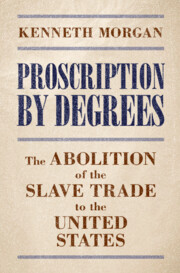
Proscription by Degrees

-
Select format
-
- Publisher:
- Cambridge University Press
- Publication date:
- 22 December 2025
- 06 November 2025
- ISBN:
- 9781009597913
- 9781009597944
- 9781009597920
- Dimensions:
- (229 x 152 mm)
- Weight & Pages:
- 0.541kg, 296 Pages
- Dimensions:
- (229 x 152 mm)
- Weight & Pages:
- 0.483kg, 296 Pages
You may already have access via personal or institutional login
Show more authors 
You may already have access via personal or institutional login
Book description
In this book, Kenneth Morgan provides the most comprehensive account of the abolition of the slave trade to the United States since W. E. B. Du Bois's 1896 The Suppression of the African Slave Trade to the United States of America, 1638–1870. Utilising a wider range of resources and exploring the economic, social, moral and political considerations, Morgan creates a multi-layered account that explains whyabolition was a protracted affair that proceeded by degrees over nearly half a century. He appraises the role of abolitionist individuals, groups and societies in bringing abolition to the forefront of public discussion across North America, and the decisive role of the US Constitution and the Constitutional Convention that eventually led to proscription in 1808, which made abolition constitutionally possible.
Reviews
‘In this deeply researched, well-written and accessible book, Kenneth Morgan highlights the dynamic, often erratic effort to end the slave trade to the US. Building on the pioneering work of W.E.B. DuBois, Morgan’s work provides an important historical account of the movement to end the slave trade.’
Julie L. Holcomb - author of Moral Commerce: Quakers and the Transatlantic Boycott of the Slave Labor Economy and editor of Quaker History
‘This book offers by far the best guide through the maze of colonial, state, and federal legislation on the transatlantic slave trade. Kenneth Morgan has done the field a great favor.’
Sean M. Kelley - Professor of History at the University of Essex. He is the author of American Slavers: Merchants, Mariners, and the Transatlantic Commerce in Captives, 1644–1865
‘Proscription By Degrees is the most significant addition to scholarship on the abolition of the trans-Atlantic slave trade to have appeared in a great many years. Morgan’s excellent book will become required reading for everyone interested in this subject.’
Simon P. Newman - Professor Emeritus, University of Glasgow. He is the author of Freedom Seekers: Escaping from Slavery in Restoration London
Contents
Contents
Metrics
Full text views
Full text views helpTotal number of HTML views: 0
Total number of PDF views: 0 *
 Loading metrics...
* Views captured on Cambridge Core between #date#. This data will be updated every 24 hours.
Usage data cannot currently be displayed.
Accessibility standard: WCAG 2.2 AAA
Why this information is here
This section outlines the accessibility features of this content - including support for screen readers, full keyboard navigation and high-contrast display options. This may not be relevant for you.
Accessibility Information
The PDF of this book complies with version 2.2 of the Web Content Accessibility Guidelines (WCAG), offering more comprehensive accessibility measures for a broad range of users and attains the highest (AAA) level of WCAG compliance, optimising the user experience by meeting the most extensive accessibility guidelines.
Content Navigation
Table of contents navigation
Allows you to navigate directly to chapters, sections, or non‐text items through a linked table of contents, reducing the need for extensive scrolling.
Index navigation
Provides an interactive index, letting you go straight to where a term or subject appears in the text without manual searching.
Reading Order and Textual Equivalents
Single logical reading order
You will encounter all content (including footnotes, captions, etc.) in a clear, sequential flow, making it easier to follow with assistive tools like screen readers.
Visual Accessibility
Use of colour is not sole means of conveying information
You will still understand key ideas or prompts without relying solely on colour, which is especially helpful if you have colour vision deficiencies.
Use of high contrast between text and background colour
You benefit from high‐contrast text, which improves legibility if you have low vision or if you are reading in less‐than‐ideal lighting conditions.