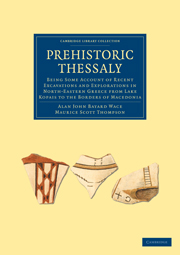

This study of prehistoric artefacts and ruins discovered in north-east Greece by the team of archaeologists led by A. J. B. Wace and M. S. Thompson was first published in 1912, thirty years after that area first revealed prehistoric remains. The one hundred and twenty sites in the Thessaly area have yielded domestic artefacts and ruins ranging from spit supports to tombs. These are depicted through detailed sketches, photographs and descriptions. The evolving architecture uncovered at different strata at the excavation sites, and the changing forms of the artefacts discovered alongside them, are explored in relation to other Greek excavation sites to determine any possible historic significance. Modern technological advances have taken some aspects of archaeology in a very different direction, but the practices of meticulous data collection and comparative analysis between sites and strata demonstrated here provide a valuable lesson in establishing a chronology of cultural and domestic development.
Loading metrics...
* Views captured on Cambridge Core between #date#. This data will be updated every 24 hours.
Usage data cannot currently be displayed.
This section outlines the accessibility features of this content - including support for screen readers, full keyboard navigation and high-contrast display options. This may not be relevant for you.
Accessibility compliance for the PDF of this book is currently unknown and may be updated in the future.
