Skip to main content Accessibility help
×
  • Coming soon
    • Edited by Brad W. Butcher, University of Pittsburgh School of Medicine, Pennsylvania
    Show more authors
  • Select format
  • Publisher:
    Cambridge University Press
    Publication date:
    15 January 2026
    22 January 2026
    ISBN:
    9781009501477
    9781009501484
    Dimensions:
    Weight & Pages:
    Dimensions:
    (234 x 156 mm)
    Weight & Pages:
    0.25kg, 800 Pages
Selected: Digital
Add to cart View cart Buy from Cambridge.org

Book description

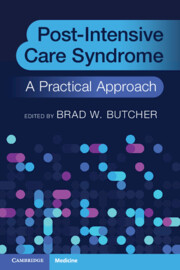
This practical book offers in-depth explorations of the pathophysiology of post-intensive care syndrome (PICS), risk factors for its development, strategies for prevention, approaches to diagnosis and management, and general principles of ICU survivorship and aftercare, accompanied by case studies and personal perspectives from survivors of critical illness and their loved ones. An international, interprofessional group of experts covers key topics, including delirium, ICU-acquired weakness, and other hazards of hospitalization; the ABCDEF bundle, ICU diaries, and family-centred care; ICU follow-up clinics and peer support programs; and comprehensive rehabilitation strategies and therapeutic interventions both in and after the hospital. Special populations, including older adults, children, those with long-COVID syndrome, and survivors of neurological injury and cardiac arrest are also discussed. The book is essential reading for physicians, nurses, and allied health professionals caring for this patient population and serves as a detailed reference to help patients with PICS better understand the condition.

Metrics

Full text views

Total number of HTML views: 0
Total number of PDF views: 0 *

Loading metrics...

Book summary page views

Total views: 0 *
Loading metrics...

* Views captured on Cambridge Core between #date#. This data will be updated every 24 hours.

Usage data cannot currently be displayed.

Accessibility standard: Missing or limited accessibility features

Why this information is here

This section outlines the accessibility features of this content - including support for screen readers, full keyboard navigation and high-contrast display options. This may not be relevant for you.

Accessibility Information

The PDF of this book is known to have missing or limited accessibility features. We may be reviewing its accessibility for future improvement, but final compliance is not yet assured and may be subject to legal exceptions. If you have any questions, please contact accessibility@cambridge.org.

Content Navigation
Table of contents navigation

Allows you to navigate directly to chapters, sections, or non‐text items through a linked table of contents, reducing the need for extensive scrolling.

Index navigation

Provides an interactive index, letting you go straight to where a term or subject appears in the text without manual searching.

Reading Order and Textual Equivalents
Single logical reading order

You will encounter all content (including footnotes, captions, etc.) in a clear, sequential flow, making it easier to follow with assistive tools like screen readers.

Short alternative textual descriptions

You get concise descriptions (for images, charts, or media clips), ensuring you do not miss crucial information when visual or audio elements are not accessible.

Visual Accessibility
Use of colour is not sole means of conveying information

You will still understand key ideas or prompts without relying solely on colour, which is especially helpful if you have colour vision deficiencies.

Structural and Technical Features
ARIA roles provided

You gain clarity from ARIA (Accessible Rich Internet Applications) roles and attributes, as they help assistive technologies interpret how each part of the content functions.