
Skip to main content Accessibility help
×
  • Cited by 88
    • Show more authors
    • You may already have access via personal or institutional login
    • Select format
    • Publisher:
      Cambridge University Press
      Publication date:
      September 2009
      June 2002
      ISBN:
      9780511492112
      9780521806640
      9780521001380
      Dimensions:
      (228 x 152 mm)
      Weight & Pages:
      0.61kg, 314 Pages
      Dimensions:
      (228 x 152 mm)
      Weight & Pages:
      0.496kg, 314 Pages
    You may already have access via personal or institutional login
  • Selected: Digital
    Add to cart View cart Buy from Cambridge.org

    Book description

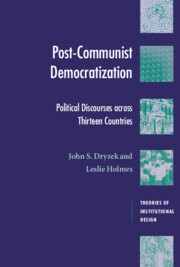
    Democracy is not just a matter of constitutions, parliaments, elections, parties and the rule of law. In order to see if or how democracy works, we must attend to what people make of it, and what they think they are doing as they engage with politics, or as politics engages them. This book examines the way democracy and democratization are thought about and lived by people in China, Russia and eleven other countries in the post-communist world. It shows how democratic politics (and sometimes authoritarian politics) work in these countries, and generates insights into the prospects for different kinds of political development. The authors explore the implications for what is probable and possible in terms of trajectories of political reform, and examine four roads to democratization: liberal, republican, participatory and statist. The book will be of interest to students and scholars of comparative politics, political theory and post-communist studies.

    Reviews

    ‘ … readers can learn a fair amount about conditions in the individual countries concerned.’

    Source: Slavonica

    ‘ … this volume is nuanced, sympathetic to national differences and fully addresses some of the deterministic impulses of the standard democratization literature.’

    Source: South East European Review

    ‘Post-Communist Democratization is a valuable addition to the study of the democratization of the former communist countries … the book strongly opposes the hasty and sometimes politically motivated works based on cultural determination and is a welcome addition to the field of democratic theory. it is a highly recommended read for those democratization experts who believe that a more thorough study of the events of the last 10–15 years in the former communist block is yet to be done.’

    Source: Acta Politica

    ‘Post-Communist Democratization is an excellent piece of work. It was a well-conceived project, the findings of which have been equally well presented. It is a book that will be of interest to area specialists as well as those with a broader interest in theories of democracy. It is a pity that there are not more studies of this calibre available.

    Source: Democratization

    Refine List

    Actions for selected content:

    Select all | Deselect all
    • View selected items
    • Export citations
    • Download PDF (zip)
    • Save to Kindle
    • Save to Dropbox
    • Save to Google Drive

    Save Search

    You can save your searches here and later view and run them again in "My saved searches".

    Please provide a title, maximum of 40 characters.
    ×

    Contents

    References
    Ágh, Attila. 1993. The “Comparative Revolution” and the Transition in Central and Southern Europe. Journal of Theoretical Politics, 5 (2): 231–52
    Ágh, Attila 1999. Processes of Democratization in the East Central European and Balkan States: Sovereignty-Related Conflicts in the Context of Europeanization. Communist and Post-Communist Studies, 32 (3): 263–79
    Alker, Hayward R. Jr., and David Sylvan. 1986. Political Discourse Analysis. Paper presented at the Annual Meeting of the American Political Science Association, Washington, DC
    Anonymous. 1999. Constitution Watch: Belarus. East European Constitutional Review Online, 8 (4) online at http://www.law.nyu.edu/eecr/vol8num4/constitutionwatch/belarus.html
    Anonymous. 2000. Constitution Watch: Moldova. East European Constitutional Review, 9 (1–2) online at http://www.law.nyu.edu/eecr/vol9num_onehalf/constitutionwatch/moldova.html
    Arato, Andrew. 1993. Interpreting 1989. Social Research, 60: 609–46
    Arendt, Hannah. 1958. The Human Condition. Chicago: University of Chicago Press
    Ascherson, Neal. 1982. The Polish August: The Self-Limiting Revolution. New York: Viking
    Auer, Stefan. 2000. Nationalism in Central Europe: A Chance or a Threat for the Emerging Liberal Democratic Order?East European Politics and Societies, 14 (2): 213–45
    Avineri, Shlomo. 1997. State Weakness as an Obstacle to Democratization. East European Constitutional Review, 6 (1): 94–9
    Bankowicz, Marek. 1994a. Bulgaria: The Continuing Revolution. 219–37 in Berglund and Dellenbrant, 1994
    Bankowicz, Marek. 1994b. Czechoslovakia: From Masaryk to Havel. 142–68 in Berglund and Dellenbrant, 1994
    Beck, Ulrich. 1992. Risk Society: Towards a New Modernity. London: Sage
    Beck, Ulrich, Anthony Giddens, and Scott Lash. 1994. Reflexive Modernization: Politics, Tradition and Aesthetics in the Modern Social Order. Cambridge: Polity
    Bell, John D. 1991. Modernization through Secularization in Bulgaria. 15–32 in Gerasimos Augustinos (ed.), Diverse Paths to Modernity in Southeastern Europe. New York: Greenwood
    Bell-Fialkoff, Andrew. 1993. A Brief History of Ethnic Cleansing. Foreign Affairs, 72 (3): 110–21
    Berglund, Sten, and Jan Åke Dellenbrant (eds.). 1994. The New Democracies in Eastern Europe: Party Systems and Political Cleavages, 2nd edn. Aldershot: Edward Elgar
    Berglund, Sten, Tomas Hellén, and Frank Aarebrot (eds.). 1998. The Handbook of Political Change in Eastern Europe. Cheltenham: Edward Elgar
    Bernhard, Michael. 1996. Civil Society after the First Transition: Dilemmas of Post-Communist Democratization in Poland and beyond. Communist and Post-Communist Studies, 29 (3): 309–30
    Bertsch, Gary. 1973. The Revival of Nationalisms. Problems of Communism, 22 (6): 1–15
    Bielasiak, Jack. 1997. Substance and Process in the Development of Party Systems in East Central Europe. Communist and Post-Communist Studies, 30 (1): 23–44
    Binder, Leonard, et al. 1971. Crises and Sequences in Political Development. Princeton, NJ: Princeton University Press
    Birch, Sarah, and Wilson, Andrew. 1999. The Ukrainian Parliamentary Elections of 1998. Electoral Studies, 18 (2): 276–82
    Block, Fred. 1977. The Ruling Class Does Not Rule: Notes on the Marxist Theory of the State. Socialist Revolution, 7: 6–28
    Bollen, Kenneth. 1980. Issues in the Comparative Measurement of Political Democracy. American Sociological Review, 45 (3): 370–90
    Bourdieu, Pierre. 1990. In Other Words. Cambridge: Polity
    Bourdieu, Pierre. 1993. The Field of Cultural Production. New York: Columbia University Press
    Bowles, Paul, and Dong, Xiao-yuan. 1994. Current Success and Future Challenge in China's Economic Reforms. New Left Review, 208: 49-76
    Bremmer, Ian, and Ray Taras (eds.). 1993. Nations and Politics in the Soviet Successor States. Cambridge: Cambridge University Press
    Bremmer, Ian, and Ray Taras (eds.). 1997. New States, New Politics: Building the Post-Soviet Nations. Cambridge: Cambridge University Press
    , Breslauer, , George, Brada, Josef, Gaddy, Clifford, Ericson, Richard, Saivetz, Carol, and Winston, Victor. 2000. Russia at the End of Yel'tsin's Presidency. Post-Soviet Affairs, 16 (1): 1–32
    Brown, Archie. 1999. Russia and Democratization. Problems of Post-Communism, 46 (5): 3–13
    Brown, Archie 2000. Transnational Influences in the Transition from Communism. Post-Soviet Affairs, 16 (2): 177–200
    Brown, James F. 1994. Hopes and Shadows: Eastern Europe After Communism. Durham, NC: Duke University Press
    Brown, Steven R. 1980. Political Subjectivity: Applications of Q Methodology in Political Science. New Haven, CT: Yale University Press
    Brown, Steven R. 1986. Q Technique and Method: Principles and Procedures. 57–76 in William D. Berry and Michael S. Lewis-Beck (eds.), New Tools for Social Scientists. Beverly Hills, CA: Sage
    Brubaker, Rogers. 1996. Nationalism Reframed: Nationhood and the National Question in the New Europe. Cambridge: Cambridge University Press
    Brucan, Silviu. 1992. Democracy at Odds with the Market in Post-Communist Societies. 19–25 in Michael Keren and Gur Ofer (eds.), Trials of Transition: Economic Reform in the Former Soviet Bloc. Boulder, CO: Westview
    Bryant, Christopher, and Edmund Mokrzycki. 1994. Introduction: Theorizing the Changes in East-Central Europe. 1–13 in Christopher Bryant and Edmund Mokrzycki (eds.), The New Great Transformation? Change and Continuity in East-Central Europe. London: Routledge
    Brzezinski, Zbigniew. 1993. The Great Transformation. National Interest, 33: 3–13
    Bunce, Valerie. 1995a. Paper Curtains and Paper Tigers. Slavic Review, 54 (4): 979–80
    Bunce, Valerie 1995b. Should Transitologists be Grounded?Slavic Review, 54 (1): 111–27
    Bunce, Valerie 1999a. The Political Economy of Postsocialism. Slavic Review, 58 (4): 756–93
    Bunce, Valerie 1999b. Subversive Institutions: The Design and Destruction of Socialism and the State. Cambridge: Cambridge University Press
    Bútora, Martin. 1999. The Present State of Democracy in Slovakia. 93–104 in Kaldor and Vejvoda, 1999
    Campbell, Adrian. 1996. Local Government and the Centre in Romania and Moldova. 73–112 in Gibson and Hanson, 1996
    Canovan, Margaret E. 1987. Republicanism. 433–6 in David Miller (ed.), The Blackwell Encyclopaedia of Political Thought. Oxford: Basil Blackwell
    Carassava, Anthee. 2000. A Greek Tragedy. Time Europe. April 10
    Carpenter, Michael. 1997. Slovakia and the Triumph of Nationalistic Populism. Communist and Post-Communist Studies, 30: 205–20
    CCTV (China Central TV). 1988. He shang [River elegy]. June
    Chirot, Daniel (ed.). 1989a. Causes and Consequences of Backwardness. 1–14 in Chirot 1989b
    Chirot, Daniel 1989b. The Origins of Backwardness in Eastern Europe: Economics and Politics from the Middle Ages until the Early Twentieth Century. Berkeley: University of California Press
    Cohen, Lenard. 1995. Broken Bonds. Boulder, CO: Westview
    Commisso, Ellen. 1997. Is the Glass Half Full or Half Empty? Reflections on Five Years of Competitive Politics in Eastern Europe. Communist and Post-Communist Studies, 30: 1–21
    Crampton, Richard. 1997. A Concise History of Bulgaria. Cambridge: Cambridge University Press
    Crowther, William. 1997a. Moldova: Caught between Nation and Empire. 316–49 in Bremmer and Taras, 1997
    Crowther, William. 1997b. The Politics of Democratization in Postcommunist Moldova. 282–329 in Dawisha and Parrott, 1997b
    Cumings, Bruce. 1999. Parallax Visions: Making Sense of American–East Asian Relations at the End of the Century. Durham, NC: Duke University Press
    Dawisha, Karen, and Bruce Parrott (eds.). 1997a. The Consolidation of Democracy in East-Central Europe. Cambridge: Cambridge University Press
    Dawisha, Karen, and Bruce Parrott (eds.). 1997b. Democratic Changes and Authoritarian Reactions in Russia, Ukraine, Belarus, and Moldova. Cambridge: Cambridge University Press
    Dawisha, Karen, and Bruce Parrott (eds.). 1997c. Politics, Power, and the Struggle for Democracy in South-East Europe. Cambridge: Cambridge University Press
    de Winter, Lieven, and Huri Türsan (eds.). 1998. Regionalist Parties in Western Europe. London: Routledge
    Dellenbrant, Jan Åke. 1994. Romania: The Slow Revolution. 203–18 in Berglund and Dellenbrant, 1994
    Di Palma, Giuseppe. 1990. To Craft Democracies. Berkeley: University of California Press
    Di Palma, Giuseppe. 1993. Why Democracy Can Work in Eastern Europe. 257–67 in Larry Diamond and Marc Plattner (eds.), The Global Resurgence of Democracy. Baltimore: Johns Hopkins University Press
    Dimitrijevic, Vojin. 1994. The 1974 Constitution as a Factor in the Collapse of Yugoslavia or as a Sign of Decaying Totalitarianism. Working Paper, RSC No. 94/9. Florence: European University Institute
    Dimitrijevic, Vojin. 1996. Sukobi oko ustava iz 1974 [Conflicts over the 1974 Constitution]. 447–71 in Popov, 1996
    Dimitrov, Georgi, Petya Kabakchieva, and Zheko Kiossev. 1996. Russia and Bulgaria: Farewell Democracy. Sofia: LIK Publishing House
    Dinkic, Mladjen. 1995. Ekonomija destrukcije: velika pljacka naroda [The economy of destruction: great robbery of the nation]. Belgrade: Vin
    Dittmer, Lowell. 1987. Public and Private Interests and the Participatory Ethic in China. 18–27 in Victor C. Falkenheim (ed.), Citizens and Groups in Contemporary China. Ann Arbor: Center for Chinese Studies, University of Michigan
    Djordjevich, Dusan. 1999. Report on South-Eastern Europe: Concepts, Histories, Boundaries. Report on a conference held at the School of Slavonic and East European Studies, University of London, June 19. Online at http://www.ssees.ac.uk/concrept.htm
    Dryzek, John S. 1994. Australian Discourses of Democracy. Australian Journal of Political Science, 29: 221–39
    Dryzek, John S. 1996a. Democracy in Capitalist Times: Ideals, Limits and Struggles. New York: Oxford University Press
    Dryzek, John S. 1996b. Political Inclusion and the Dynamics of Democratization. American Political Science Review, 90 (3): 475–87
    Dryzek, John S., and Berejikian, Jeffrey. 1993. Reconstructive Democratic Theory. American Political Science Review, 87 (1): 48–60
    Dryzek, John S., and Holmes, Leslie. 2000. The Real World of Civic Republicanism: Making Democracy Work in Poland and the Czech Republic. Europe–Asia Studies, 52 (6): 1043–68
    Dudwick, Nora. 1997. Armenia: Paradise Lost? 471–504 in Bremmer and Taras, 1997
    Dunlop, John. 1993. Russia: Confronting a Loss of Empire. 43–72 in Bremmer and Taras, 1993
    Elster, Jon, Claus Offe, and Ulrich Preuss (with others). 1998. Institutional Design in Post-Communist Societies: Rebuilding the Ship at Sea. Cambridge: Cambridge University Press
    Encarnación, Omar. 2000. Beyond Transition: The Politics of Democratic Consolidation. Comparative Politics, 32 (4): 479–98
    European Commission. 1997. Agenda 2000: Commission Opinion on Slovakia's Application for Membership of the European Union. Brussels: European Union
    Evans, Geoffrey, and Stephen Whitefield. 1996. Cleavage Formation in Transitional Societies: Russia, Ukraine and Estonia. Unpublished paper presented at the 1996 Annual Conference of the American Political Science Association, San Francisco
    Fischer-Galati, Stephen. 1991. Twentieth-Century Romania. New York: Columbia University Press
    Fish, M. Steven. 1998. Democratization's Requisites: The Postcommunist Experience. Post-Soviet Affairs, 14 (3): 212–47
    Fish, M. Steven. 1999. Postcommunist Subversion: Social Science and Democratization in East Europe and Eurasia. Slavic Review, 58 (4): 794–823
    Fitzmaurice, John. 1998. Politics and Government in the Visegrad Countries. London: Macmillan
    Flers, René. 1984. Socialism in One Family. Survey, 28 (4): 165–75
    Frentzel-Zagorska, Janina. 1989. Semi-Free Elections in Poland. Unpublished paper presented at the Australasian Political Studies Association Annual Conference, Sydney
    Fukuyama, Francis. 1989. The End of History? National Interest, Summer: 3–18
    Fukuyama, Francis. 1992. The End of History and the Last Man. New York: Free Press
    Gallagher, Tom. 1995a. Democratization in the Balkans: Challenges and Prospects. Democratization, 2 (3): 337–61
    Gallagher, Tom. 1995b. Romania after Ceauşescu: The Politics of Intolerance. Edinburgh: Edinburgh University Press
    Ganev, Venelin I. 1997. Bulgaria's Symphony of Hope. Journal of Democracy, 8 (4): 125–40
    Garnett, , Sherman, , and Lebenson, Rachel. 1998. Ukraine Joins the Fray: Will Peace Come to Trans-Dniestria?Problems of Post-Communism, 45 (6): 22–32
    Gasiorowski, Mark J. 2000. Democracy and Macroeconomic Performance in Underdeveloped Countries. Comparative Political Studies, 33 (3): 319–49
    Gati, Charles. 1990. East-Central Europe: The Morning After. Foreign Affairs, 69 (5): 129–45
    Gati, Charles. 1996. If Not Democracy, What? Leaders, Laggards and Losers in the Post-Communist World. 168–98 in Mandelbaum, 1996
    Gibson, John, and Philip Hanson (eds.). 1996. Transformation from Below: Local Power and the Political Economy of Post-Communist Transition. Cheltenham: Edward Elgar
    Gilberg, Trond. 1990. Nationalism and Communism in Romania: The Rise and Fall of Ceauşescu's Personal Dictatorship. Boulder, CO: Westview
    Gitelman, Zvi. 1994. Nationality and Ethnicity in Russia and the Post-Soviet Republics. 237–65 in White, Pravda, and Gitelman, 1994
    Glenny, Misha. 1993. The Fall of Yugoslavia. London: Penguin
    Green, A. T., and , C. Skalnik Leff. 1997. The Quality of Democracy: Mass–Elite Linkages in the Czech Republic. Democratization, 4: 63-87
    Grzybowski, Marian. 1994. Poland: Towards Overdeveloped Pluralism. 36–73 in Berglund and Dellenbrant, 1994
    Habermas, Jürgen. 1979. Communication and the Evolution of Society. Boston: Beacon Press
    Hadzhiiski, Ivan. 1997. Optimistichna teoria za nashya narod. Sofia: Otechestvo
    Halbach, Uwe. 1997. Präkare Transformation: Reform und Stabilitätswahrung in Kaukasien und Zentralasien. 105–15 in Höhmann, 1997
    Havel, Václav, et al. 1985. The Power of the Powerless: Citizens against the State. Armonk, NY: Sharpe
    Held, Joseph (ed.). 1992. Columbia History of Eastern Europe in the Twentieth Century. New York: Columbia University Press
    Hellén, Tomas, Berglund, Sten, and Aarebrot, Frank. 1998. From Transition to Consolidation. 365–77 in Berglund, Hellén, and Aarebrot, 1998
    Hill, Ronald J. 1994. Parties and the Party System. 88–108 in White, Pravda, and Gitelman, 1994
    Hindess, Barry. 2000. Representation Ingrafted upon Democracy. Democratization, 7 (2): 1–18
    Höhmann, Hans-Hermann (chief ed.). 1997. Der Osten Europas im Prozeß der Differenzierung: Fortschritte und Miß erfolge der Transformation. Munich: Carl Hanser Verlag
    Holmes, Leslie. 1993. The End of Communist Power: Anti-Corruption Campaigns and Legitimation Crisis. New York: Oxford University Press
    Holmes, Leslie. 1996. Poland and Hungary: Two Approaches to Post-Communist Transition?Russia and Euro-Asia Bulletin, 5 (12): 1–8
    Holmes, Leslie. 1998. The Democratic State or State Democracy? Problems of Post-Communist Transition. Jean Monnet Chair Papers, no. 48. Florence: European University Institute
    Holmes, Stephen. 1995. Conceptions of Democracy in the Draft Constitutions of Post-Communist Countries. 71–81 in Beverly Crawford (ed.), Markets, States and Democracy. Boulder, CO: Westview
    Holmes, Stephen. 1996. Cultural Legacies or State Collapse? 22–76 in Mandelbaum, 1996
    Holmes, Stephen. 1997. What Russia Teaches Us Now: How Weak States Threaten Freedom. American Prospect, 33: 30–9
    Holtbrügge, Dirk. 1996. Weißrußland. Munich: Beck
    Hua, Shiping. 1992. All Roads Lead to Democracy: A Critical Analysis of the Writings of Three Chinese Reformist Intellectuals. Bulletin of Concerned Asian Scholars, 24: 43–58
    Hughes, J. 2000. Transition Models and Democratisation in Russia. 21–49 in M. Bowker and C. Ross (eds.), Russia after the Cold War. London: Longman
    Hunter, Shireen. 1993. Azerbaijan: Search for Identity and New Partners. 225–60 in Bremmer and Taras, 1993
    Huntington, Samuel. 1991. The Third Wave. Norman: University of Oklahoma Press
    Huntington, Samuel. 1996. The Clash of Civilizations and the Remaking of World Order. New York: Simon and Schuster
    Huskey, Eugene. 1999. Presidential Power in Russia. Armonk, NY: M. E. Sharpe
    Ionescu, Ghita. 1964. Communism in Romania: 1944–1962. Oxford: Oxford University Press
    Isaac, Jeffrey. 1994. Oases in the Desert: Hannah Arendt on Democratic Politics. American Political Science Review, 88 (1): 156–68
    Isiyama, John T., and Velten, Matthew. 1998. Presidential Power and Democratic Development in Post-Communist Politics. Communist and Post-Communist Studies, 31: 217–33
    Janos, Andrew C. 1995. Europe, East Central. 442–51 in Seymour Martin Lipset (ed.), Encyclopedia of Democracy, vol. Ⅱ. London: Routledge
    Jenner, William J. F. 1992. The Tyranny of History: The Roots of China's Crisis. Harmondsworth: Penguin
    Johnson, James. 1991. Rational Choice as a Reconstructive Theory. 113–42 in Kristin Monroe (ed.), The Economic Approach to Politics. New York: HarperCollins
    Jones, Stephen F. 1993. Georgia: A Failed Democratic Transition. 288–310 in Bremmer and Taras, 1993
    Jones, Stephen F. 1997. Georgia: The Trauma of Statehood. 505–43 in Bremmer and Taras, 1997
    Jones, Stephen F. 2000. Democracy from below: Interest Groups in Georgian Society. Slavic Review, 59 (1): 42–73
    Jowitt, Ken. 1992. New World Disorder: The Leninist Extinction. Berkeley: University of California Press
    Kaldor, Mary, and Vejvoda, Ivan. 1997. Democratization in Central and East European Countries. International Affairs, 73: 59–82
    Kaldor, Mary, and Ivan Vejvoda. (eds.). 1999. Democratization in Central and Eastern Europe. London: Frances Pinter
    Karasimeonov, Georgi. 1998. Bulgaria. 335–64 in Berglund, Hellén, and Aarebrot, 1998
    Karatnycky, Adrian. 1995. Ukraine at the Crossroads. Journal of Democracy, 6 (1): 117–30
    Karl, Terry Lynn, and Schmitter, Philippe. 1995. From an Iron Curtain to a Paper Curtain: Grounding Transitologists or Students of Postcommunism?Slavic Review, 54 (4): 965–78
    Kavan, Zdeněk and Martin Palouš. 1999. Democracy in the Czech Republic. 78–92 in Kaldor and Vejvoda, 1999
    Kettle, Steve. 1995. Of Money and Morality. Transition, 1 (3): 36–9
    King, Charles. 2000. The Moldovans: Romania, Russia and the Politics of Culture. Stanford, CA: Hoover Institution Press
    Kirschbaum, Stanislav. 1995. A History of Slovakia: The Struggle for Survival. London: Macmillan
    Kitschelt, Herbert, Zdenka Mansfeldova, Radslaw Markowski, and Gábor Tóka. 1999. Post-Communist Party Systems: Competition, Representation and Inter-Party Cooperation. Cambridge: Cambridge University Press
    Kitzinger, Celia. 1986. Introducing and Developing Q as a Feminist Methodology. 151–72 in Sue Wilkinson (ed.), Feminist Social Psychology. Milton Keynes: Open University Press
    Kolarova, Rumyana. 1999. Democratization in Bulgaria: Recent Trends. 150–61 in Kaldor and Vejvoda, 1999
    Konrád, George [György]. 1984. Antipolitics. Boca Raton, FL: CRC
    Kopecky, Petr, and Mudde, Cas. 2000. What Has Eastern Europe Taught Us about the Democratisation Literature (and Vice Versa)?European Journal of Political Research, 37: 517–39
    Korbonski, Andrzej. 1994. From Annus Mirabilis to Annus Horribilis? Poland 1989–1993. 219–33 in Joan Serafin (ed.), East-Central Europe in the 1990s. Boulder, CO: Westview
    Krawchenko, Bohdan. 1993. Ukraine: The Politics of Independence. 75–98 in Bremmer and Taras, 1993
    Król, Marcin. 1999. Democracy in Poland. 67–77 in Kaldor and Vejvoda, 1999
    Kuzio, Taras, and Andrew Wilson. 1994. Ukraine: Perestroika to Independence. London: Macmillan
    Lang, David. 1962. A Modern History of Georgia. London: Weidenfeld and Nicolson
    Lang, David. 1970. Armenia: Cradle of Civilisation. London: Allen and Unwin
    Lei, Guang. 1996. Elusive Democracy: Conceptual Change and the Chinese Democracy Movement, 1978–9 to 1989. Modern China, 22 (4): 417–47
    Lewis, Paul G. 1995. Poland's New Parties in the Post-Communist Political System. 29–47 in Gordon Wightman (ed.), Party Formation in East-Central Europe: Post-Communist Politics in Czechoslovakia, Hungary, Poland and Bulgaria. Cheltenham: Edward Elgar
    Lijphart, Arend. 1984. Democracies: Patterns of Majoritarian and Consensus Government in Twenty-One Countries. New Haven, CT: Yale University Press
    Linz, Juan J., and Alfred E. Stepan. 1996. Problems of Democratic Transition and Consolidation: Southern Europe, South America, and Post-Communist Europe. Baltimore: Johns Hopkins University Press
    Lipset, Seymour Martin. 1959. Some Social Requisites of Democracy: Economic Development and Political Legitimacy. American Political Science Review, 53 (1): 69–105
    Lipset, Seymour Martin, and Stein Rokkan. 1967. Cleavage Structures, Party Systems and Voter Alignments: An Introduction. 1–64 in Seymour Martin Lipset and Stein Rokkan (eds.), Party Systems and Voter Alignments. New York: Free Press
    Lydall, Harold. 1986. Yugoslav Socialism. Oxford: Oxford University Press
    Macintyre, Alasdair. 1973. Is a Science of Comparative Politics Possible? 171–88 in A. Ryan (ed.), The Philosophy of Social Explanation. Oxford: Oxford University Press
    Mandelbaum, Michael (ed.). 1996. Post-Communism: Four Perspectives. New York: Council on Foreign Relations
    Markus, Ustina. 1995a. Heading off an Energy Disaster. Transition, 1 (5): 10–13
    Markus, Ustina. 1995b. Still Coming to Terms with Independence. Transition, 1 (2): 47–52
    Marples, David. 1993. Belarus: The Illusion of Stability. Post-Soviet Affairs, 9 (3): 253–77
    Marples, David. 1999. Belarus: A Denationalized Nation. Amsterdam: Horwood
    Marsh, Christopher. 2000. Social Capital and Democracy in Russia. Communist and Post-Communist Studies, 33 (2): 183–99
    Mihajlovic, Srecko, et al. 1991. Od izbornih rituala do slobodnih izbora [From election rituals to free elections]. Belgrade: Univerzitet u Beogradu IDN
    Miháliková, Silvia. 1996. The Painful Birth of Slovak Democratic Political Culture. Slovak Sociological Review, 1: 51–68
    Mihalisko, Kathleen J. 1997. Belarus: Retreat to Authoritarianism. 223–81 in Dawisha and Parrott, 1997b
    Mihut, Liliana. 1994. The Emergence of Political Pluralism in Romania. Communist and Post-Communist Studies, 27 (4): 411–22
    Miklos, Ivan, 1998. Privatization. 117–26 in Martin Bútora and Thomas W. Skladony (eds.), Slovakia 1996–1997: A Global Report on the State of Society. Bratislava: Institute for Public Affairs
    Miller, Arthur H., Erb, Gwyn, Reisinger, William M., and Hesli, Vicki L.. 2000. Emerging Party Systems in Post-Soviet Societies: Fact or Fiction?Journal of Politics, 62 (2): 455–90
    Miller, Nicholas J. 1997. A Failed Transition: The Case of Serbia. 146–88 in Dawisha and Parrott, 1997a
    Miller, William, Stephen White, and Paul Heywood. 1998. Values and Political Change in Postcommunist Europe. New York: St. Martin's Press
    Mitev, Petar-Emil. 1997. Party Manifestos for the Bulgarian 1994 Elections. Journal of Communist Studies and Transition Politics, 13 (1): 64–90
    Moore, Barrington. 1967. Social Origins of Dictatorship and Democracy. Harmondsworth: Penguin
    Mueller, John. 1996. Democracy, Capitalism, and the End of Transition. 102–67 in Mandelbaum, 1996
    Munck, Geraldo L., and Leff, Carol Skalnik. 1997. Modes of Transition and Democratization: South America and Eastern Europe in Comparative Perspective. Comparative Politics, 29: 343–63
    Murrell, Peter. 1993. What Is Shock Therapy? What Did It Do in Poland and Russia?Post-Soviet Affairs, 9 (2): 111–40
    Musil, Jiří (ed.). 1995. The End of Czechoslovakia. Budapest: Central European University Press
    Nagy-Talavera, Nicolas. 1967. The Green Shirts and Others: A History of Fascism in Hungary and Romania. Berkeley: University of California Press
    Nathan, Andrew. 1985. Chinese Democracy. New York: Knopf
    Nathan, Andrew, and Shi, Tianjian. 1993. Cultural Requisites for Democracy in China: Findings from a Survey. Daedalus, 122: 95–123
    Nelson, Lynn, and Amonashvili, Paata. 1992. Voting and Political Attitudes in Soviet Georgia. Soviet Studies, 44 (4): 687–97
    Nodia, Ghia. 1995. Georgia's Identity Crisis. Journal of Democracy, 6 (1): 104–16
    O'Donnell, Guillermo. 1994. Delegative Democracy. Journal of Democracy, 5 (1): 55–69
    O'Donnell, Guillermo, and Philippe Schmitter. 1986. Transitions from Authoritarian Rule: Tentative Conclusions about Uncertain Democracies. Baltimore: Johns Hopkins University Press
    Offe, Claus. 1991. Capitalism by Democratic Design: Democratic Theory Facing the Triple Transition in East Central Europe. Social Research, 58: 865–92
    Oi, Jean. 1992. Fiscal Reform and the Economic Foundations of Local State Corporatism in China. World Politics, 45 (1): 99–126
    OSCE. 1997. Human Rights and Democratization in Slovakia. Organization for Security and Cooperation in Europe, September
    Ost, David. 1993. The Politics of Interest in Post-Communist Eastern Europe. Theory and Society, 22: 453–86
    Pateman, Carole. 1970. Participation and Democratic Theory. Cambridge: Cambridge University Press
    Peng, Yali. 1996. The Politics of Tobacco: Relations between Farmers and Local Governments in China's Southwest. China Journal, 36: 67-82
    Peng, Yali. 1998. Democracy and Chinese Political Discourses. Modern China, 24: 408–44
    Pesic, Vesna. 1996. The War for Nation States. 3–59 in Popov, 1996
    Pickel, Andreas. 1993. Authoritarianism or Democracy? Marketization as a Political Problem. Policy Sciences, 26: 139–63
    Pickvance, Chris. 1999. Democratisation and the Decline of Social Movements: The Effects of Regime Change on Collective Action in Eastern Europe, Southern Europe and Latin America. Sociology, 33 (2): 353–72
    Pippidi, Alina Mungiu. 1999. Romania: From Procedural Democracy to European Integration. 135–49 in Kaldor and Vejvoda, 1999
    Plasser, Fritz, Peter A. Ulram, and Harald Waldrauch. 1998. Democratic Consolidation in East-Central Europe. Houndmills: Macmillan
    Plichtová, Jana, and Erös, Ferenc. 1997. Meaning of Some Political and Economic Terms in Relation to Experience of Two Slovak and Hungarian Generations. Sociológica, 29: 723–37
    Popov, Nebojsa (ed.). 1996. Srpska strana rata. [The Serbian side of the war]. Belgrade: Republika
    Powell, G. Bingham. 1982. Contemporary Democracies: Participation, Stability, and Violence. Cambridge, MA: Harvard University Press
    Powers, Denise. 1998. Authenticating Democratic Transitions: Bringing the Demos (back) in. Unpublished typescript, University of Iowa
    Prizel, Ilya. 1997. Ukraine between Proto-Democracy and “Soft” Authoritarianism. 330–69 in Dawisha and Parrott, 1997b
    Prybyla, Jan S. 1989. Why China's Economic Reforms Fail. Asian Survey, 29: 1017–32
    Przeworski, Adam. 1991. Democracy and the Market: Political and Economic Reforms in Eastern Europe and Latin America. Cambridge: Cambridge University Press
    Przeworski, Adam, Michael E. Alvarez, Jose Antonio Cheibub, and Fernando Limongi. 2000. Democracy and Development: Political Institutions and Well-Being in the World, 1950–1990. Cambridge: Cambridge University Press
    Przeworski, Adam, and Limongi, Fernando. 1997. Modernization: Theories and Facts. World Politics, 49 (2): 155–83
    Putnam, Robert D. 1993. Making Democracy Work: Civic Traditions in Modern Italy. Princeton, NJ: Princeton University Press
    Pye, Lucian. 1966. Aspects of Political Development. Boston, MA: Little Brown
    Pye, Lucian. 1985. Asian Power and Politics: The Cultural Dimensions of Authority. Cambridge, MA: Harvard University Press
    Rady, Martyn. 1992. Romania in Turmoil. London: Tauris
    Ramet, Sabrina. 1997. Democratization in Slovenia: The Second Stage. 189–225 in Dawisha and Parrott, 1997c
    Ratesh, Nestor. 1991. Romania: The Entangled Revolution. New York: Praeger
    Remington, Thomas F. 1997. Democratization and the New Political Order in Russia. 69–129 in Dawisha and Parrott, 1997b
    Remington, Thomas F. 2000. Putin's Third Way: Russia and the “Strong State” Ideal. East European Constitutional Review, 9 (1–2), online at http://www.law.nyu.edu/eecr/vol9num_onehalf/feature/strongstate.html
    Renmin ribao [People's Daily], September 7, 1994
    Renmin ribao, haiwai ban [People's Daily, overseas edition], October 5, 1995
    Rose, Richard. 2000a. How Floating Parties Frustrate Democratic Accountability: A Supply-Side View of Russia's Elections. East European Constitutional Review, 9 (1–2), online at http://www.law.nyu.edu/eecr/vol9num_onehalf/feature/supplyside.html
    Rose, Richard. 2000b. Uses of Social Capital in Russia: Modern, Pre-Modern, and Anti-Modern. Post-Soviet Affairs, 16 (1): 33–57
    Rose, Richard, and William Mishler. 1993. Reacting to Regime Change in Eastern Europe. Glasgow: University of Strathclyde Studies in Public Policy, No. 210
    Rose, Richard, William Mishler, and Christian Haerpfer. 1998. Democracy and Its Alternatives: Understanding Post-Communist Societies. Cambridge: Polity
    Rostow, Walter. 1971. Politics and the Stages of Growth. Cambridge: Cambridge University Press
    Rueschemeyer, Dietrich, Evelyn Huber Stephens, and John D. Stephens. 1992. Capitalist Development and Democracy. Chicago: University of Chicago Press
    Rupnik, Jacques. 1981. The Restoration of the Party-State in Czechoslovakia since 1968. 105–24 in Leslie Holmes (ed.), The Withering Away of the State: Party and State under Communism. London: Sage
    Rusinow, Dennison. 1977. The Yugoslav Experiment 1948–1974. London: Hurst
    Rutland, Peter. 1994. Democracy and Nationalism in Armenia. Europe–Asia Studies, 46 (5): 839–61
    Sabbat-Swidlicka, Anna. 1993. The Polish Elections: The Church, the Right and the Left. RFE/RL Research Report, 2 (40): 24–30
    Sakwa, Richard. 1999. Postcommunism. Buckingham: Open University Press
    Sakwa, Richard, and Webber, Mark. 1999. The Commonwealth of Independent States, 1991–1998: Stagnation and Survival. Europe–Asia Studies, 51 (3): 379–415
    Sandel, Michael J. 1996. Democracy's Discontent: America in Search of a Public Philosophy. Cambridge, MA: Harvard University Press
    Sartori, Giovanni. 1976. Parties and Party Systems: A Framework for Analysis. Cambridge: Cambridge University Press
    Sartori, Giovanni. 1991. Rethinking Democracy: Bad Polity and Bad Politics. International Social Science Journal, 129: 437–50
    Schedler, A. 1998. What Is Democratic Consolidation?Journal of Democracy, 9: 91–107
    Schmitter, Philippe, and Karl, Terry Lynn. 1994. The Conceptual Travels of Transitologists and Consolidologists: How Far to the East Should They Attempt to Go?Slavic Review, 53 (1): 173–85
    Schneider, Eberhard. 1997. Begriffe und theoretische Konzepte zur politischen Transformation. 17–25 in Höhmann, 1997
    Schöpflin, George. 1993. Politics in Eastern Europe. Oxford: Blackwell
    Schumpeter, Joseph A. 1942. Capitalism, Socialism, and Democracy. New York: Harper
    Schwartz, Karl-Peter. 1993. Tschechen und Slowaken: Der lange Weg zur friedlichen Trennung. Vienna: Europaverlag
    Seidel, Gill. 1985. Political Discourse Analysis. 43–60 in Teun A. van Dijk (ed.), Handbook of Discourse Analysis, vol. Ⅳ. London: Academic
    Seleny, Anna. 1999. Old Political Rationalities and New Democracies: Compromise and Confrontation in Hungary and Poland. World Politics, 51 (4): 484–519
    Sher, G. 1977. Praxis. Bloomington: Indiana University Press
    Shevtsova, Lilia, and Bruckner, Scott. 1997. Where Is Russia Headed? Toward Stability or Crisis?Journal of Democracy, 8 (1): 12–26
    Shue, Vivienne. 1992. China: Transition Postponed?Problems of Communism, 41: 157–65
    Shulhyn, A. 1963. The Period of the Central Rada (Council). 725–46 in Volodymyr Kubijovič (ed.), Ukraine: A Concise Encyclopedia, vol. Ⅰ. Toronto: University of Toronto Press
    Šimečka, Martin. 1997. Slovakia's Lonely Independence. Transitions, 4 (3): 14–21
    Šimečka, Martin, and Stefan Hríb. 1999. Slovensko nie je dierou na mape Európy [Slovakia is not a hole on the map of Europe; an interview with Madeleine Albright]. Domino Fórum, January 20–27, 1999
    Skilling, H. Gordon. 1976. Czechoslovakia's Interrupted Revolution. Princeton, NJ: Princeton University Press
    Skilling, H. Gordon. 1981. Charter 77 and Human Rights in Czechoslovakia. London: George Allen and Unwin
    Skocpol, Theda. 1979. States and Social Revolutions. Cambridge: Cambridge University Press
    Sowards, Steven. 1996. Lecture 12: Bosnia-Hercegovina and the Failure of Reform in Austria-Hungary. On-line at http://www.lib.msu.edu/sowards/balkan/lect12htm
    Stepan, Alfred, and Skach, Cindy. 1993. Constitutional Frameworks and Democratic Consolidation: Parliamentarism vs. Presidentialism. World Politics, 46 (1): 1–22
    Stephenson, William. 1953. The Study of Behavior: Q Technique and Its Methodology. Chicago: University of Chicago Press
    Stokes, Gail. 1989. The Social Origins of East European Politics. 210–51 in Chirot, 1989b
    Stone, Daniel Z. 1990. Democratic Thought in Eighteenth-Century Poland. 55–72 in M. B. Biskupski and James S. Pula (eds.), Polish Democratic Thought from the Renaissance to the Great Emigration. New York: Columbia University Press
    Subtelny, Orest. 1998. Ukraine: A History. 2nd edn. Toronto: University of Toronto Press
    Sunstein, Cass R. 1988. Beyond the Republican Revival. Yale Law Journal, 97 (8): 1539–90
    Suny, Ronald. 1989. The Making of the Georgian Nation. London: Tauris
    Suny, Ronald. 1993. Looking toward Ararat: Armenia in Modern History. Bloomington: Indiana University Press
    Suny, Ronald. 2000. Review of Joseph R. Masih and Robert O. Krikorian, Armenia: At the Crossroads. Europe–Asia Studies, 52: 726–7
    Suster, Zeljan E. 1998. Development of Political Democracy and Political Party Pluralism in Serbia 1903–1914. East European Quarterly, 31 (4): 435–48
    Szomolányi, Sona. 1997. Slovakia: Problems of Democratic Consolidation and the Struggle for the Rules of the Game. Bratislava: Slovak Political Science Association and Friedrich Ebert Foundation
    Tétrault, Mary Ann, and Robin L. Teske. 1997. The Struggle to Democratize the Slovak Republic. Current History, March: 135–9
    Tigrid, Pavel. 1975. The Prague Coup of 1948: The Elegant Takeover. 399–432 in Thomas Hammond (ed.), The Anatomy of Communist Takeovers. New Haven, CT: Yale University Press
    Tilly, Charles. 1993. European Revolutions, 1492–1992. Oxford: Basil Blackwell
    Timmermann, Heinz, and Alexander Ott. 1997. Restauration und Reaktion in Belarus. 94–105 in Höhmann, 1997
    Tismaneanu, Vladimir. 1998. Fantasies of Salvation: Democracy, Nationalism, and Myth in Post-Communist Europe. Princeton, NJ: Princeton University Press
    Tismaneanu, Vladimir. 1999. Understanding National Stalinism: Reflections on Ceauşescu's Socialism. Communist and Post-Communist Studies, 32 (2): 155–73
    Todorova, Maria. 1997. Imagining the Balkans. New York: Oxford University Press
    Tolz, Vera. 1998. Forging the Nation: National Identity and Nation Building in Post-Communist Russia. Europe–Asia Studies, 50 (6): 993–1022
    Tolz, Vera, and Busygina, Irina. 1997. Regional Governors and the Kremlin: The Ongoing Battle for Power. Communist and Post-Communist Studies, 30 (4): 401–26
    Tompson, W. 2000. Putin's Power Plays. World Today, 56 (7): 14–16
    Toulmin, Stephen. 1958. The Uses of Argument. Cambridge: Cambridge University Press
    Unger, Roberto M., and Cui, Zhiyuan. 1994. China in the Russian Mirror. New Left Review, 208: 78–87
    Urban, Michael, with Vyacheslav Igrunov and Sergei Mitrokhin. 1997. The Rebirth of Politics in Russia. Cambridge: Cambridge University Press
    Urban, Michael, and Jan Zaprudnik. 1993. Belarus: A Long Road to Nationhood. 99–120 in Bremmer and Taras, 1993
    Utechin, Sergei. 1964. Russian Political Thought: A Concise History. New York: Praeger
    Vachudová, Milada, and Snyder, Tim. 1997. Are Transitions Transitory? Two Types of Political Change in Eastern Europe since 1989. East European Politics and Societies, 11: 1–35
    Verdery, Katherine. 1991. National Ideology under Socialism: Identity and Cultural Politics in Ceauşescu's Romania. Berkeley: University of California Press
    Verheijen, Tony. 1995. Constitutional Pillars for New Democracies: The Cases of Bulgaria and Romania. Leiden: DSWO Press
    Walicki, Andrzej. 1989. The Enlightenment and the Birth of Modern Nationhood: Polish Political Thought from Noble Republicanism to Tadeusz Kościuszko. Notre Dame, IN: University of Notre Dame Press
    Wallerstein, Immanuel. 1974. The Modern World System. New York: Academic Press
    Wheaton, Bernard, and Zdeněk Kavan. 1992. The Velvet Revolution. Boulder, CO: Westview
    White, Gordon. 1994. Democratization and Economic Reform in China. Australian Journal of Chinese Affairs, 31: 73–92
    White, Stephen, Judy Batt, and Paul Lewis (eds.). 1993. Developments in East European Politics. London: Macmillan
    White, Stephen, Alex Pravda, and Zvi Gitelman (eds.). 1994. Developments in Russian and Post-Soviet Politics. London: Macmillan
    Wightman, Gordon. 1993. The Czech and Slovak Republics. 51–65 in White, Batt and Lewis, 1993
    Wilson, Andrew. 1997. Ukraine: Two Presidents and Their Powers. 67–105 in Ray Taras (ed.), Postcommunist Presidents. Cambridge: Cambridge University Press
    Wilson, Andrew, and Bilous, Artur. 1993. Political Parties in Ukraine. Europe–Asia Studies, 45 (4): 693–703
    Wise, Charles R., and Brown, Trevor L.. 1999. The Separation of Powers in Ukraine. Communist and Post-Communist Studies, 32 (1): 23–44
    Wolchik, Sharon. 1992. Czechoslovakia. 119–63 in Held, 1992
    Wolchik, Sharon. 1995. The Politics of Transition and the Break-Up of Czechoslovakia. 225–44 in Musil, 1995
    Wolinetz, Steven B. (ed.). 1998. Party Systems. Aldershot: Ashgate
    Yenal, Oktay. 1990. Chinese Reforms, Inflation and the Allocation of Investment in a Socialist Economy. World Development, 18: 707–21
    Žák, Václav. 1995. The Velvet Divorce: Institutional Foundations. 245–68 in Musil, 1995
    Zakaria, Fareed. 1997. The Rise of Illiberal Democracy. Foreign Affairs, 76 (6): 22–43
    Zaprudnik, Jan. 1993. Belarus: At a Crossroads in History. Boulder, CO: Westview
    Zhang, Mingshu. 1994. Zhongguo “zhengzhi ren” (The Chinese “political man”). Beijing: Zhongguo shehui kexue chubanshe
    Zhu, , Jianhua, , Zhao, Xinshu, and Li, Hairong. 1990. Public Political Consciousness in China: An Empirical Profile. Asian Survey, 30: 992–1006

    Metrics

    Altmetric attention score

    Full text views

    Total number of HTML views: 0
    Total number of PDF views: 0 *
    Loading metrics...

    Book summary page views

    Total views: 0 *
    Loading metrics...

    * Views captured on Cambridge Core between #date#. This data will be updated every 24 hours.

    Usage data cannot currently be displayed.

    Accessibility standard: Unknown

    Why this information is here

    This section outlines the accessibility features of this content - including support for screen readers, full keyboard navigation and high-contrast display options. This may not be relevant for you.

    Accessibility Information

    Accessibility compliance for the PDF of this book is currently unknown and may be updated in the future.
