
Skip to main content Accessibility help
×
  • Cited by 1
    • Show more authors
    • You may already have access via personal or institutional login
    • Select format
    • Publisher:
      Cambridge University Press
      Publication date:
      10 October 2024
      05 September 2024
      ISBN:
      9781009314305
      9781009314299
      Dimensions:
      (229 x 152 mm)
      Weight & Pages:
      0.72kg, 408 Pages
      Dimensions:
      Weight & Pages:
    You may already have access via personal or institutional login
  • Selected: Digital
    Add to cart View cart Buy from Cambridge.org

    Book description

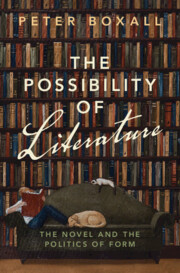
    The Possibility of Literature is an essential collection from one of the most powerful and distinctive voices in contemporary literary studies. Bringing together key compositions from the last twenty-five years, as well as several new pieces, the book demonstrates the changing fate of literary thinking over the first decades of the twenty-first century. Peter Boxall traces here the profound shifts in the global conditions that make literature possible as these have occurred in the historical passage from 9/11 to Covid 19. Exploring questions such as 'The Idea of Beauty', the nature of 'Mere Being', or the possibilities of Rereading, the author anatomises the myriad forces that shape the literary imagination. At the same time, he gives vivid critical expression to the imaginative possibilities of literature itself – those unique forms of communal life that literature makes possible in a dramatically changing world, and that lead us towards a new shared future.

    Reviews

    ‘The bracing lucidity of Boxall's prose can guide us, captivated, through books we may not know while bringing seasoned masterworks before us as if we'd never read them before-from the ‘immensity' of the ‘mere' in James to the Proustian corpus as its own model of rereading, from the ontological drama of tautology in late DeLillo to the implant and dismantlement of Dickensian realist scaffolds in post-millennial British novels. Even as its founding conditions are probed anew, literary writing-honoring the ‘hinge' of Boxall's title-opens startling cognitive possibilities charted here in essays of high and liberating intelligence.'

    Garrett Stewart - James O. Freedman Professor of Letters, University of Iowa

    ‘In this groundbreaking study, leading scholar of the novel Peter Boxall considers what makes literature possible-and what literature makes possible-at a time when the very survival of the planet looks increasingly impossible.  The climate emergency, Boxall contends, puts in question the relation between culture and nature, human and inhuman, requiring an overhaul of existing critical and creative modes.  Ranging widely from Cervantes to Maria Edgeworth to Emily Dickinson; from Herman Melville and W. B. Yeats, to Henry James, Marcel Proust and Virginia Woolf; from Philip Roth and Don DeLillo to James Kelman, Kazuo Ishiguro and Zadie Smith, Boxall argues that their writing presses against limits to open up a glimpse of possibility, however fleeting and ungraspable.  ‘This capacity of literary writing to exceed its own terms,' Boxall proposes, ‘is the engine of literary possibility.''

    Maud Ellmann - Randy L. and Melvin R. Berlin Distinguished Service Professor Emerita, University of Chicago

    Refine List

    Actions for selected content:

    Select all | Deselect all
    • View selected items
    • Export citations
    • Download PDF (zip)
    • Save to Kindle
    • Save to Dropbox
    • Save to Google Drive

    Save Search

    You can save your searches here and later view and run them again in "My saved searches".

    Please provide a title, maximum of 40 characters.
    ×

    Contents

    Metrics

    Full text views

    Total number of HTML views: 0
    Total number of PDF views: 0 *
    Loading metrics...

    Book summary page views

    Total views: 0 *
    Loading metrics...

    * Views captured on Cambridge Core between #date#. This data will be updated every 24 hours.

    Usage data cannot currently be displayed.

    Accessibility standard: Unknown

    Why this information is here

    This section outlines the accessibility features of this content - including support for screen readers, full keyboard navigation and high-contrast display options. This may not be relevant for you.

    Accessibility Information

    Accessibility compliance for the PDF of this book is currently unknown and may be updated in the future.
