
Skip to main content Accessibility help
×
  • Cited by 5
    • The digital format of this book is no longer available to purchase from Cambridge Core. Other formats may be available.
    • This product has been replaced by an open access version 9781009281386
    • Show more authors
    • You may already have access via personal or institutional login
    • Select format
    • Publisher:
      Cambridge University Press
      Publication date:
      Invalid date
      September 2021
      ISBN:
      9781108495950
      Dimensions:
      (228 x 152 mm)
      Weight & Pages:
      0.59kg, 306 Pages
      Dimensions:
      Weight & Pages:
    You may already have access via personal or institutional login
    Selected: Digital
    Add to cart View cart Buy from Cambridge.org

    Book description

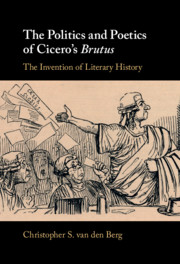
    Cicero's Brutus (46 BCE), a tour-de-force of intellectual and political history, was written amidst political crisis: Caesar's defeat of the republican resistance at the battle of Thapsus. This magisterial example of the dialogue genre capaciously documents the intellectual vibrancy of the Roman Republic and its Greco-Roman traditions. This book is the first study of the work from several distinct yet interrelated perspectives: Cicero's account of oratorical history, the confrontation with Caesar, and the exploration of what it means to write a history of an artistic practice. Close readings of this dialogue-including its apparent contradictions and tendentious fabrications-reveal a crucial and crucially productive moment in Greco-Roman thought. Cicero, this book argues, created the first nuanced, sophisticated, and ultimately 'modern' literary history, crafting both a compelling justification of Rome's oratorical traditions and also laying a foundation for literary historiography that abides to this day.

    Reviews

    ‘a fine study … Recommended.’

    A. M. Keith Source: Choice Connect

    ‘… van den Berg’s book is an ambitious, well-argued, and timely work that offers a wealth of approaches to a challenging text with a complex reception history. Like the Brutus itself, it deftly straddles the often-siloed disciplines of history and literary criticism to provide valuable insight into the confluence of art and politics at a critical point in the story of Rome.’

    Noah Segal Source: Bryn Mawr Classical Review

    ‘Anyone who has spent time with Cicero’s Brutus will discover much to interest them in this book. It is also an important contribution to the study of ancient literary criticism, and makes a strong case for including Cicero as an innovative voice within that genre (as he certainly should be). … I would highly recommend this book to anyone who wants to understand how Cicero’s choices over two thousand years ago still shape the way we think about literary history today.’

    Caroline Bishop Source: GNOMON

    Refine List

    Actions for selected content:

    Select all | Deselect all
    • View selected items
    • Export citations
    • Download PDF (zip)
    • Save to Kindle
    • Save to Dropbox
    • Save to Google Drive

    Save Search

    You can save your searches here and later view and run them again in "My saved searches".

    Please provide a title, maximum of 40 characters.
    ×

    Contents

    Metrics

    Altmetric attention score

    Full text views

    Total number of HTML views: 0
    Total number of PDF views: 0 *
    Loading metrics...

    Book summary page views

    Total views: 0 *
    Loading metrics...

    * Views captured on Cambridge Core between #date#. This data will be updated every 24 hours.

    Usage data cannot currently be displayed.

    Accessibility standard: Unknown

    Why this information is here

    This section outlines the accessibility features of this content - including support for screen readers, full keyboard navigation and high-contrast display options. This may not be relevant for you.

    Accessibility Information

    Accessibility compliance for the PDF of this book is currently unknown and may be updated in the future.
