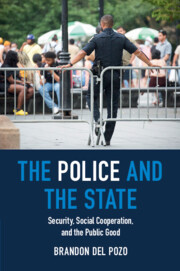

As we wrestle with the role and limits of policing, a political philosopher who spent over two decades as a New York City police officer and Vermont chief of police presents a normative account of what it means to police a pluralist democracy. Invoking his vast experience, Brandon del Pozo argues that we all have the prerogative to use force to protect others, but police embody the government's unique duty to do so effectively and with restraint. He recasts order maintenance as brokering and enforcing the fair terms of social cooperation in our public spaces, for the protection of minority interests, and for a society where diverse conceptions of the good can flourish. The reasons why we police, he says, must be ones that all citizens can evaluate as equals. His book explains the democratic commitments of policing, and lays the groundwork for meaningful police innovation and reform.
‘Brandon Del Pozo's book utilizes a Rawlsian framework to provide a normative framework for policing. To date, his is the most detailed and sophisticated attempt to do so. Whether one ultimately accepts this approach or some alternative, such as a rights-based approach, his book is a significant contribution to police ethics.'
Seumas Miller - Charles Sturt University, Delft University of Technology and University of Oxford
Loading metrics...
* Views captured on Cambridge Core between #date#. This data will be updated every 24 hours.
Usage data cannot currently be displayed.
This section outlines the accessibility features of this content - including support for screen readers, full keyboard navigation and high-contrast display options. This may not be relevant for you.
Accessibility compliance for the PDF of this book is currently unknown and may be updated in the future.
