
Skip to main content Accessibility help
×
  • Cited by 6
    • Show more authors
    • You may already have access via personal or institutional login
    • Select format
    • Publisher:
      Cambridge University Press
      Publication date:
      31 August 2021
      09 September 2021
      ISBN:
      9781009026826
      9781316515860
      9781009011792
      Dimensions:
      (229 x 152 mm)
      Weight & Pages:
      0.55kg, 288 Pages
      Dimensions:
      (229 x 152 mm)
      Weight & Pages:
      0.45kg, 288 Pages
    You may already have access via personal or institutional login
  • Selected: Digital
    Add to cart View cart Buy from Cambridge.org

    Book description

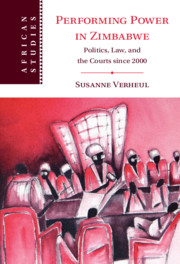
    Focusing on political trials in Zimbabwe's Magistrates' Courts between 2000 and 2012, Susanne Verheul explores why the judiciary have remained a central site of contestation in post-independence Zimbabwe. Drawing on rich court observations and in-depth interviews, this book foregrounds law's potential to reproduce or transform social and political power through the narrative, material, and sensory dimensions of courtroom performances. Instead of viewing appeals to law as acts of resistance by marginalised orders for inclusion in dominant modes of rule, Susanne Verheul argues that it was not recognition by but of this formal, rule-bound ordering, and the form of citizenship it stood for, that was at stake in performative legal engagements. In this manner, law was much more than a mere instrument. Law was a site in which competing conceptions of political authority were given expression, and in which people's understandings of themselves as citizens were formed and performed.

    Reviews

    ‘In Verheul’s masterful account, law shapes (and is shaped by) political subjectivities and norms in crisis-ridden post-colonial Zimbabwe. We see how law works within the state and how meaningful legal practices, claims and institutions can be, for both those in authority and those who resist.’

    Sara Rich Dorman - University of Edinburgh

    ‘Through a finely crafted interweaving of detailed courtroom ethnography, revealing interviews and carefully read legal documents, Susanne Verheul eloquently unfolds the complex relationships between history, law, politics, state authority and citizenship. While contextualised within Zimbabwe, this rich account and its analytical insights has great significance for a wide range of scholarly fields.’

    Amanda Hammar - University of Copenhagen

    ‘A fascinating and vividly painted picture of the way in which power gets enacted in Zimbabwe’s courtrooms and a must-read for socio-legal scholars and Africanists alike. Verheul manages to combine disciplinary perspectives and rich case material to dig deep into how power gets constituted and is performed. Highly recommended!’

    Barbara Oomen - Utrecht University

    Refine List

    Actions for selected content:

    Select all | Deselect all
    • View selected items
    • Export citations
    • Download PDF (zip)
    • Save to Kindle
    • Save to Dropbox
    • Save to Google Drive

    Save Search

    You can save your searches here and later view and run them again in "My saved searches".

    Please provide a title, maximum of 40 characters.
    ×

    Contents

    Metrics

    Altmetric attention score

    Full text views

    Total number of HTML views: 0
    Total number of PDF views: 0 *
    Loading metrics...

    Book summary page views

    Total views: 0 *
    Loading metrics...

    * Views captured on Cambridge Core between #date#. This data will be updated every 24 hours.

    Usage data cannot currently be displayed.

    Accessibility standard: Unknown

    Why this information is here

    This section outlines the accessibility features of this content - including support for screen readers, full keyboard navigation and high-contrast display options. This may not be relevant for you.

    Accessibility Information

    Accessibility compliance for the PDF of this book is currently unknown and may be updated in the future.
