
Skip to main content Accessibility help
×
  • Cited by 1
    • Show more authors
    • You may already have access via personal or institutional login
    • Select format
    • Publisher:
      Cambridge University Press
      Publication date:
      December 2024
      December 2024
      ISBN:
      9781009289245
      9781009289276
      Dimensions:
      (229 x 152 mm)
      Weight & Pages:
      0.96kg, 592 Pages
      Dimensions:
      Weight & Pages:
    You may already have access via personal or institutional login
  • Selected: Digital
    Add to cart View cart Buy from Cambridge.org

    Book description

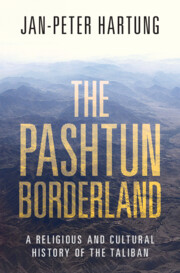
    Since the Taliban returned to power in Afghanistan in 2021, the need to understand the group's history and ideology has only increased. Jan-Peter Hartung's timely study examines the phenomenon of the Taliban through a topographically, ethnically and geo-politically distinct space: the Pashtun Borderland of today's Afghanistan and Pakistan. Emphasising the central role of Pashtun ethnicity, Hartung covers approximately five hundred years of Pashtun history: from the early modern Mughal empire to the first Durrani Empire in the eighteenth century and the regional developments during the colonial period in the nineteenth and early twentieth century. Drawing from a wealth of primary source materials in Pashto, Persian, Urdu and Arabic, Hartung moves the discussion of the Taliban beyond the immediacy of journalistic reportage and security-orientated studies, to a nuanced analysis of a wide range of actors and ideologies, refracting Afghanistan's present moment through the lens of its long cultural and religious history.

    Reviews

    ‘This impressive volume makes multiple crucial interventions in the literature on Pashtuns. Hartung excavates vast reservoirs of local language sources for a longue durée social history that reframes the geographical context of cultural production using the borderscape concept while productively addressing class and other hierarchies in this polyvalent ideological space.’

    Shah Mahmoud Hanifi - James Madison University

    ‘This is a deeply researched and illuminating history of the origins of the Taliban in the borderlands of contemporary Afghanistan and Pakistan. It is masterful in elucidating the processes that have shaped Islam and politics in this region and how they have come to be embodied in the phenomenon of the Taliban.’

    Muhammad Qasim Zaman - Princeton University

    Refine List

    Actions for selected content:

    Select all | Deselect all
    • View selected items
    • Export citations
    • Download PDF (zip)
    • Save to Kindle
    • Save to Dropbox
    • Save to Google Drive

    Save Search

    You can save your searches here and later view and run them again in "My saved searches".

    Please provide a title, maximum of 40 characters.
    ×

    Contents

    Metrics

    Altmetric attention score

    Full text views

    Total number of HTML views: 0
    Total number of PDF views: 0 *
    Loading metrics...

    Book summary page views

    Total views: 0 *
    Loading metrics...

    * Views captured on Cambridge Core between #date#. This data will be updated every 24 hours.

    Usage data cannot currently be displayed.

    Accessibility standard: Unknown

    Why this information is here

    This section outlines the accessibility features of this content - including support for screen readers, full keyboard navigation and high-contrast display options. This may not be relevant for you.

    Accessibility Information

    Accessibility compliance for the PDF of this book is currently unknown and may be updated in the future.
