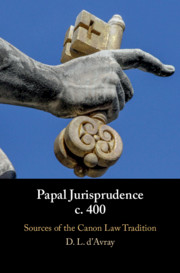

In the late fourth century, in the absence of formal church councils, bishops from all over the Western Empire wrote to the Pope asking for advice on issues including celibacy, marriage law, penance and heresy, with papal responses to these questions often being incorportated into private collections of canon law. Most papal documents were therefore responses to questions from bishops, and not initiated from Rome. Bringing together these key texts, this volume of accessible translations and critical transcriptions of papal letters is arranged thematically to offer a new understanding of attitudes towards these fundamental issues within canon law. Papal Jurisprudence, c.400 reveals what bishops were asking, and why the replies mattered. It is offered as a companion to the forthcoming volume Papal Jurisprudence: Social Origins and Medieval Reception of Canon Law, 385–1234.
'The history of the papacy in the early Middle Ages is plagued with conflicting scholarly interpretations of its role, importance, and doctrines. David L. d’Avray has written a masterfully lucid analysis of the first papal letters, papal authority and institutions, and the problems the bishops of Rome faced as they strove to create a universal set of norms for the church.'
Ken Pennington - Catholic University of America
‘It is a superb book.’
Kenneth Pennington Source: Speculum: A Journal of Medieval Studies
'… d’Avray’s book provides important insights for scholars and students of the medieval Church. It shows the importance of the fifth century as a formative period, when papal jurisprudence took shape as the result of the exchange of letters between popes and bishops.'
Barbara Bombi Source: English Historical Review
‘This story, based on a lifetime of research, is told by reference to the political, social, and economic conditions of the times so as to make it extremely engaging. … It is a splendid work of detailed research, erudite yet readable, which forms a notable contribution to the literature on canon law and especially its development. I cannot praise it too highly.’
John Duddington Source: Law and Justice
Loading metrics...
* Views captured on Cambridge Core between #date#. This data will be updated every 24 hours.
Usage data cannot currently be displayed.
This section outlines the accessibility features of this content - including support for screen readers, full keyboard navigation and high-contrast display options. This may not be relevant for you.
Accessibility compliance for the PDF of this book is currently unknown and may be updated in the future.
