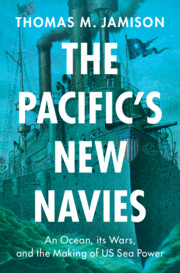
The Pacific's New Navies

-
Select format
-
- Publisher:
- Cambridge University Press
- Publication date:
- 05 December 2024
- 12 December 2024
- ISBN:
- 9781009559706
- 9781009559737
- 9781009559744
- Dimensions:
- (229 x 152 mm)
- Weight & Pages:
- 0.61kg, 304 Pages
- Dimensions:
- (229 x 152 mm)
- Weight & Pages:
- 0.45kg, 304 Pages
You may already have access via personal or institutional login
Show more authors 
You may already have access via personal or institutional login
Book description
The initial creation of the United States' ocean-going battlefleet – otherwise known as the 'New Navy' – was a result of the naval wars and arms races around the Pacific during the late-nineteenth century. Using a transnational methodology, Thomas Jamison spotlights how US Civil War-era innovations catalyzed naval development in the Pacific World, creating a sense that the US Navy was falling behind regional competitors. As the industrializing 'newly-made navies' of Chile, Peru, Japan, and China raced against each other, Pacific dynamism motivated investments in the US 'New Navy as a matter of security and civilizational prestige. In this provocative exploration into the making of modern US navalism, Jamison provides an analysis of competitive naval build-ups in the Pacific, of the interactions between peoples, ideas, and practices within it, and ultimately the emergence of the US as a major power.
Reviews
'With engaging prose and storytelling, The Pacific's New Navies brings the rise of the US Navy at the start of the 20th century into a new light. Through a transwar lens, Jamison reminds readers that any pivot to the Pacific is not new in American history and the study of the history of the Pacific World is vital to understanding our 21st century challenges.'
Benjamin Armstrong - editor of 21st Century Mahan: Sound Military Conclusions for the Modern Era
'America’s rise to global power in the 20th century cannot be understood without the growth of the US Navy in the 19th century, and that growth of the US Navy cannot be understood without this marvelous book. Jamison uses a capacious array of multi-archival sources, subtle analysis, and deft prose to center the Pacific theater in the geographical nativity of America’s naval modernization. Scholars, students, and strategists should all take heed of this fresh, compelling, and timely history.'
William Inboden - Hamilton Center for Classical and Civic Education, University of Florida
'This is an extraordinary book. By explaining the creation of a late 19th century US navy through American rivalries with other rising Pacific states, it shows how globalization and technology drove US military transformation well before clashes with European powers took central stage.'
O. A. Westad - author (with Chen Jian) of The Great Transformation: China’s Road form Revolution to Reform
Contents
Contents
References
Metrics
Altmetric attention score
Full text views
Full text views helpTotal number of HTML views: 0
Total number of PDF views: 0 *
 Loading metrics...
* Views captured on Cambridge Core between #date#. This data will be updated every 24 hours.
Usage data cannot currently be displayed.
Accessibility standard: Unknown
Why this information is here
This section outlines the accessibility features of this content - including support for screen readers, full keyboard navigation and high-contrast display options. This may not be relevant for you.
Accessibility Information
Accessibility compliance for the PDF of this book is currently unknown and may be updated in the future.