Operation Wrath of God

-
Select format
-
- Publisher:
- Cambridge University Press
- Publication date:
- 12 August 2025
- 07 August 2025
- ISBN:
- 9781009503068
- 9781009503075
- Dimensions:
- (229 x 152 mm)
- Weight & Pages:
- 0.68kg, 350 Pages
- Dimensions:
- Weight & Pages:
You may already have access via personal or institutional login
Show more authors 
You may already have access via personal or institutional login
Book description
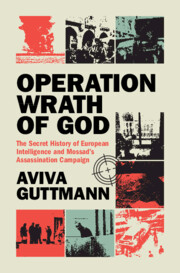
In this unprecedented history of intelligence cooperation during the Cold War, Aviva Guttmann uncovers the key role of European intelligence agencies in facilitating Mossad's Operation Wrath of God. She reveals how, in the aftermath of the 1972 Munich Olympics Massacre, Palestinians suspected of involvement in terrorism were hunted and killed by Mossad with active European cooperation. Through unique access to unredacted documents in the Club de Berne archive, she shows how a secret coalition of intelligence agencies supplied Mossad with information about Palestinians on a colossal scale and tacitly supported Israeli covert actions on European soil. These agencies helped to anticipate and thwart a number of Palestinian terrorist plots, including some revealed here for the first time. This extraordinary book reconstructs the hidden world of international intelligence, showing how this parallel order enabled state relations to be pursued independently of official foreign policy constraints or public scrutiny.
Reviews
‘This book reads like a John Le Carré thriller. Packed with new revelations and gripping details, itstands out as the most authoritative account of Operation Wrath of God.’
Ahron Bregman - author of The Spy Who Fell to Earth
‘This is a remarkable, beautifully written and carefully researched book on the highly secret world ofinternational co-operation between intelligence services. It also sheds important new light onassassination as a tool of foreign policy.’
Richard J. Aldrich - author of GCHQ
‘This well-researched insightful book lifts the lid on the contribution of European intelligenceagencies to Israel’s Operation Wrath of God which was directed towards eliminating Palestiniangroups such as Black September, responsible for the killing of athletes at the Munich Olympics in1972. The author has revealed the work of the ‘Club de Berne’ and its liaison with the Mossad and shone a bright light on those who live in the shadows.’
Colin Shindler - author of A History of Modern Israel
‘Based on ground-breaking research from a rare archive in Switzerland. Guttmann lifts the lid onMossad’s most secret ‘licence to kill’ operations in Europe, with the aid of other westernintelligence agencies. A gripping and tense narrative.’
Helen Fry - author of Spymaster: The Man who saved MI6
‘Dr Guttmann has produced a gripping historical account that is both riveting and terrifying in equal measure. It has the fast-paced adventure of a novel. This is more than a history book, and is as relevant today as the period it covers. I cannot recommend it highly enough.’
Michael Goodman - author of The Official History of the Joint Intelligence Committee
'a timely and worthy contribution to intelligence history'
Roger Boyes Source: The Times
‘Guttmann reveals how the intelligence-sharing network the Club de Berne aided Israel in avenging the 1972 Munich Olympics.’
Alan Judd Source: The Spectator
‘For all its riveting tales of Israeli agents getting next to hijackers by dressing as airline mechanics, or attempts to shoot down Meir’s plane with surface-to-air missiles, 'Operation Wrath of God' is a serious book that raises important questions about how Israel used intelligence from its partners.’
Michael Allen Source: The Wall Street Journal
‘This fascinating account of Israeli counterterrorism is based on unique access to a huge cache of original documents.’
Robert Low Source: The Jewish Chronicle
‘Guttmann benefitted from the study of archives … to acquire a sophisticated understanding of how European states were co-operating themselves and with Israel to pursue their own national goals.’
Edward N. Luttwak Source: Times Literary Supplement
Contents
Contents
References
Metrics
Full text views
Full text views helpTotal number of HTML views: 0
Total number of PDF views: 0 *
 Loading metrics...
* Views captured on Cambridge Core between #date#. This data will be updated every 24 hours.
Usage data cannot currently be displayed.
Accessibility standard: WCAG 2.0 AA
Why this information is here
This section outlines the accessibility features of this content - including support for screen readers, full keyboard navigation and high-contrast display options. This may not be relevant for you.
Accessibility Information
The PDF of this book conforms to version 2.0 of the Web Content Accessibility Guidelines (WCAG), ensuring core accessibility principles are addressed and achieves the intermediate (AA) level of WCAG compliance, covering a wider range of accessibility requirements.
Content Navigation
Table of contents navigation
Allows you to navigate directly to chapters, sections, or non‐text items through a linked table of contents, reducing the need for extensive scrolling.
Index navigation
Provides an interactive index, letting you go straight to where a term or subject appears in the text without manual searching.
Reading Order and Textual Equivalents
Single logical reading order
You will encounter all content (including footnotes, captions, etc.) in a clear, sequential flow, making it easier to follow with assistive tools like screen readers.
Short alternative textual descriptions
You get concise descriptions (for images, charts, or media clips), ensuring you do not miss crucial information when visual or audio elements are not accessible.
Structural and Technical Features
ARIA roles provided
You gain clarity from ARIA (Accessible Rich Internet Applications) roles and attributes, as they help assistive technologies interpret how each part of the content functions.