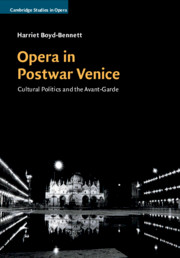

Beginning from the unlikely vantage point of Venice in the aftermath of fascism and World War II, this book explores operatic production in the city's nascent postwar culture as a lens onto the relationship between opera and politics in the twentieth century. Both opera and Venice in the middle of the century are often talked about in strikingly similar terms: as museums locked in the past and blind to the future. These clichés are here overturned: perceptions of crisis were in fact remarkably productive for opera, and despite being physically locked in the past, Venice was undergoing a flourishing of avant-garde activity. Focusing on a local musical culture, Harriet Boyd-Bennett recasts some of the major composers, works, stylistic categories and narratives of twentieth-century music. The study provides fresh understandings of works by composers as diverse as Stravinsky, Prokofiev, Verdi, Britten and Nono.
Winner, 2019 Kurt Weill Prize for Distinguished Scholarship in Music Theater since 1900, The Kurt Weill Foundation for Music
Loading metrics...
* Views captured on Cambridge Core between #date#. This data will be updated every 24 hours.
Usage data cannot currently be displayed.
This section outlines the accessibility features of this content - including support for screen readers, full keyboard navigation and high-contrast display options. This may not be relevant for you.
Accessibility compliance for the PDF of this book is currently unknown and may be updated in the future.
