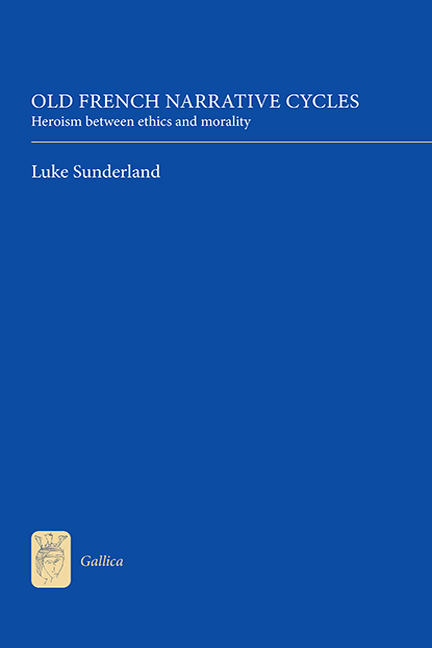
Old French Narrative Cycles

-
Select format
-
- Publisher:
- Boydell & Brewer
- Publication date:
- 09 May 2017
- 15 April 2010
- ISBN:
- 9781846158063
- 9781843842200
- Dimensions:
- Weight & Pages:
- Dimensions:
- Weight & Pages:
- Subjects:
- Literature, Area Studies, European History 1000-1450, History, Anglo Saxon and Medieval Literature, European Studies
- Series:
- Gallica
You may already have access via personal or institutional login- Subjects:
- Literature, Area Studies, European History 1000-1450, History, Anglo Saxon and Medieval Literature, European Studies
- Series:
- Gallica
Show more authors 
You may already have access via personal or institutional login
Book description
This is a study of four colossal medieval works - the Cycle de Guillaume d'Orange, the Vulgate Cycle, the Prose Tristan and the Roman de Renart - which are normally considered separately. By placing them side-by-side for analysis, Luke Sunderland is able to argue for an aesthetic of cyclicity that cuts across genre. He combines detailed readings of the narrative infrastructure of each cycle with attention to the shifts and transformations that come with successive acts of rewriting.
Old French Narrative Cycles focuses in particular on revisions and controversies around heroic figures, arguing that competition between alternative heroes within these texts makes them a discourse on heroism. Using a theoretical framework deriving from Lacanian psychoanalysis, the study reveals anxieties surrounding the hero's relationship to the "good": the hero oscillates between support for moral ideals and subversive assertions of freedom that can lead to evil and death. Ultimately, it is contended that the instability of the hero as conduit for morality produces textual confusion and generates the myriad differing versions of these vast and perplexing works.
LUKE SUNDERLAND is Lecturer in the School of Modern Languages and Cultures, University of Durham.
Contents
Contents
Metrics
Full text views
Full text views helpTotal number of HTML views: 0
Total number of PDF views: 0 *
 Loading metrics...
* Views captured on Cambridge Core between #date#. This data will be updated every 24 hours.
Usage data cannot currently be displayed.
Accessibility standard: Unknown
Why this information is here
This section outlines the accessibility features of this content - including support for screen readers, full keyboard navigation and high-contrast display options. This may not be relevant for you.
Accessibility Information
Accessibility compliance for the PDF of this book is currently unknown and may be updated in the future.