
Skip to main content Accessibility help
×
  • Cited by 2
    • Volume 3: Perceptual and Cognitive Processes
      Show more authors
    • You may already have access via personal or institutional login
    • Select format
    • Publisher:
      Cambridge University Press
      Publication date:
      April 2023
      April 2023
      ISBN:
      9781108902724
      9781108830676
      9781108821223
      Dimensions:
      (244 x 170 mm)
      Weight & Pages:
      1.03kg, 496 Pages
      Dimensions:
      (244 x 170 mm)
      Weight & Pages:
      0.846kg, 494 Pages
    You may already have access via personal or institutional login
  • Selected: Digital
    Add to cart View cart Buy from Cambridge.org

    Book description

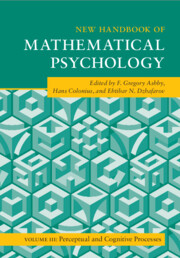
    The field of mathematical psychology began in the 1950s and includes both psychological theorizing, in which mathematics plays a key role, and applied mathematics motivated by substantive problems in psychology. Central to its success was the publication of the first Handbook of Mathematical Psychology in the 1960s. The psychological sciences have since expanded to include new areas of research, and significant advances have been made both in traditional psychological domains and in the applications of the computational sciences to psychology. Upholding the rigor of the original Handbook, the New Handbook of Mathematical Psychology reflects the current state of the field by exploring the mathematical and computational foundations of new developments over the last half-century. The third volume provides up-to-date, foundational chapters on early vision, psychophysics and scaling, multisensory integration, learning and memory, cognitive control, approximate Bayesian computation, and encoding models in neuroimaging.

    Reviews

    ‘This is the third volume of the New Handbook of Mathematical Psychology. Here, the editors, leaders in their fields, focus on ‘Perceptual and Cognitive Processes’. Mathematical psychology has come a long way since its inception in the 1950s. This volume signifies its evolution into a vital linchpin of modern scientific psychology.’

    James T. Townsend - Distinguished Professor and Rudy Professor of Psychological and Brain Sciences, Emeritus, Indiana University

    Refine List

    Actions for selected content:

    Select all | Deselect all
    • View selected items
    • Export citations
    • Download PDF (zip)
    • Save to Kindle
    • Save to Dropbox
    • Save to Google Drive

    Save Search

    You can save your searches here and later view and run them again in "My saved searches".

    Please provide a title, maximum of 40 characters.
    ×

    Contents

    Metrics

    Altmetric attention score

    Full text views

    Total number of HTML views: 0
    Total number of PDF views: 0 *
    Loading metrics...

    Book summary page views

    Total views: 0 *
    Loading metrics...

    * Views captured on Cambridge Core between #date#. This data will be updated every 24 hours.

    Usage data cannot currently be displayed.

    Accessibility standard: Unknown

    Why this information is here

    This section outlines the accessibility features of this content - including support for screen readers, full keyboard navigation and high-contrast display options. This may not be relevant for you.

    Accessibility Information

    Accessibility compliance for the PDF of this book is currently unknown and may be updated in the future.
