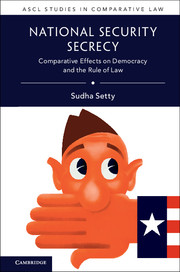

Excessive government secrecy in the name of counterterrorism has had a corrosive effect on democracy and the rule of law. In the United States, when controversial national security programs were run by the Bush and Obama administrations - including in areas of targeted killings, torture, extraordinary rendition, and surveillance - excessive secrecy often prevented discovery of those actions. Both administrations insisted they acted legally, but often refused to explain how they interpreted the governing law to justify their actions. They also fought to keep Congress from exercising oversight, to keep courts from questioning the legality of these programs, and to keep the public in the dark. Similar patterns have arisen in other democracies around the world. In National Security Secrecy, Sudha Setty takes a critical and comparative look at these problems and demonstrates how government transparency, privacy, and accountability should provide the basis for reform.
‘An illuminating discussion of the costs of secrecy and how Congress and the Courts have condoned such an anti-democratic state of affairs. Its attention to how European courts and institutions have more vigourously challenged governmental claims of secrecy is exceptional.'
Kent Roach - Professor of Law and Chair in Law and Public Policy, University of Toronto
‘With insightful analysis, Sudha Setty demonstrates how the misuse of secrecy by governments in the United States and other countries has done serious damage to individual rights, democratic values, and the rule of law. We need to restore legislative and judicial checks on misleading executive assertions.'
Louis Fisher - Scholar in Residence, The Constitution Project
‘Sudha Setty writes with remarkable dexterity about the exponential increase in the powers of the state to remain secret while enhancing national security regimes in the war against terror. Setty gives a comprehensive account of how national security secrecy is enabled legally and politically in contemporary democracies at the expense of structural accountability, rule of law and fundamental rights.'
Ujjwal Kumar Singh - University of Delhi
Loading metrics...
* Views captured on Cambridge Core between #date#. This data will be updated every 24 hours.
Usage data cannot currently be displayed.
This section outlines the accessibility features of this content - including support for screen readers, full keyboard navigation and high-contrast display options. This may not be relevant for you.
Accessibility compliance for the PDF of this book is currently unknown and may be updated in the future.
