Skip to main content Accessibility help
×
  • Cited by 1
    • Show more authors
    • You may already have access via personal or institutional login
    • Select format
    • Publisher:
      Cambridge University Press
      Publication date:
      June 2023
      July 2023
      ISBN:
      9781108993319
      9781108834469
      9781108995085
      Dimensions:
      (216 x 138 mm)
      Weight & Pages:
      0.46kg, 258 Pages
      Dimensions:
      (216 x 140 mm)
      Weight & Pages:
      0.33kg, 258 Pages
    You may already have access via personal or institutional login
  • Selected: Digital
    Add to cart View cart Buy from Cambridge.org

    Book description

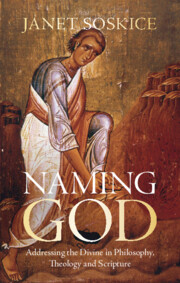
    Generations of Christians, Janet Soskice demonstrates, once knew God and Christ by hundreds of remarkable names. These included the appellations 'Messiah', 'Emmanuel', 'Alpha', 'Omega', 'Eternal', 'All-Powerful', 'Lamb', 'Lion', 'Goat', 'One', 'Word', 'Serpent' and 'Bridegroom'. In her much-anticipated new book, Soskice argues that contemporary understandings of divinity could be transformed by a return to a venerable analogical tradition of divine naming. These ancient titles – drawn from scripture – were chanted and sung, crafted and invoked (in polyphony and plainsong) as they were woven into the worship of the faithful. However, during the sixteenth century Descartes moved from 'naming' to 'defining' God via a series of metaphysical attributes. This made God a thing among things: a being amongst beings. For the author, reclaiming divine naming is not only overdue. It can also re-energize the relationship between philosophy and religious tradition. This path-breaking book shows just how rich and revolutionary such reclamation might be.

    Awards

    Finalist, 2024 PROSE- Humanities, Association of American Publishers

    Reviews

    ‘Skilfully and insightfully written, this book draws on the inheritance of the author's classic text Metaphor and Religious Language while developing that inheritance in a great many interesting and engaging new directions.'

    Oliver Davies - King's College London

    ‘Naming God offers a powerful critical perspective on some of the most basic historical and theoretical assumptions in modern philosophy of religion and philosophical theology, with significant implications - both methodologically and historically - for the subject as a whole. Impressively wide-ranging, Janet Soskice's important new book makes weighty contributions to several fields. The argument is insightful and the style provocative without being polemical. The author offers mature reflection while bringing a lightness of touch to new perspectives on the reception of the tradition.'

    Carmody Grey - Durham University

    ‘Janet Soskice brings together a professional philosopher's analytical skills with those of an intellectual historian: both strictly in the service of a core theological preoccupation with how, and on what conditions, a theologian may name God. This is an essential book - wonderfully rich and challenging - and the author herself is one of the major philosophical figures of our time.'

    Denys Turner - Yale University

    'Splendid … Naming God brings together a professional philosopher's analytical skills with those of an intellectual historian and both strictly in the service of a core theological preoccupation with how, and on what conditions, a theologian may name God. It is a fine achievement.'

    Denys Turner Source: The Tablet

    ‘… masterly and very accessible … a thoughtful and thought-provoking essay by one of this country’s leading philosophical theologians.’

    John Saxbee Source: Church Times

    ‘Required reading for the practical and emotive contemporary challenges raised by the naming of God.’

    Bridget Nichols Source: Search

    ‘Naming God, on an important subject, combines learning with clarity. As such, it is a testing but deeply satisfying theological read. … This book, written at the highest level of academic expertise, has important pastoral implications for those concerned about the role of Christian faith in the secular world.’

    Richard Harries Source: Modern Believing

    ‘Naming God will be regarded as one of the most important texts of Christian theology to appear this decade.’

    Paul Allen Source: Times Literary Supplement

    ‘This work serves as a timely reminder of the importance of maintaining a balance between scriptural fidelity and philosophical inquiry. While not claiming to provide exhaustive answers, Naming God serves as a valuable starting point for further exploration and dialogue at the nexus of philosophy, theology, biblical studies, and history.’

    Gregory Shokhikyan Source: Theological Studies

    ‘Soskice’s work accomplishes what only great Christian theology can do: anchoring itself in the Christian tradition, responding to current needs, and inviting readers into deeper relationship with God.’

    Erica Ridderman Source: Religious Studies Review
    Refine List

    Actions for selected content:

    Select all | Deselect all
    • View selected items
    • Export citations
    • Download PDF (zip)
    • Save to Kindle
    • Save to Dropbox
    • Save to Google Drive

    Save Search

    You can save your searches here and later view and run them again in "My saved searches".

    Please provide a title, maximum of 40 characters.
    ×

    Contents

    Metrics

    Altmetric attention score

    Full text views

    Total number of HTML views: 0
    Total number of PDF views: 0 *
    Loading metrics...

    Book summary page views

    Total views: 0 *
    Loading metrics...

    * Views captured on Cambridge Core between #date#. This data will be updated every 24 hours.

    Usage data cannot currently be displayed.

    Accessibility standard: Unknown

    Why this information is here

    This section outlines the accessibility features of this content - including support for screen readers, full keyboard navigation and high-contrast display options. This may not be relevant for you.

    Accessibility Information

    Accessibility compliance for the PDF of this book is currently unknown and may be updated in the future.

