
Skip to main content Accessibility help
×
  • Cited by 252
    • Show more authors
    • You may already have access via personal or institutional login
    • Select format
    • Publisher:
      Cambridge University Press
      Publication date:
      June 2012
      January 2010
      ISBN:
      9780511811623
      9780521452861
      9780521459105
      Dimensions:
      (228 x 152 mm)
      Weight & Pages:
      0.74kg, 390 Pages
      Dimensions:
      (228 x 152 mm)
      Weight & Pages:
      0.52kg, 390 Pages
    You may already have access via personal or institutional login
  • Selected: Digital
    Add to cart View cart Buy from Cambridge.org

    Book description

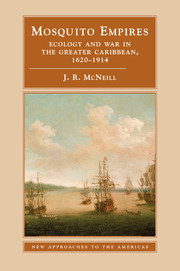
    This book explores the links among ecology, disease, and international politics in the context of the Greater Caribbean - the landscapes lying between Surinam and the Chesapeake - in the seventeenth through early twentieth centuries. Ecological changes made these landscapes especially suitable for the vector mosquitoes of yellow fever and malaria, and these diseases wrought systematic havoc among armies and would-be settlers. Because yellow fever confers immunity on survivors of the disease, and because malaria confers resistance, these diseases played partisan roles in the struggles for empire and revolution, attacking some populations more severely than others. In particular, yellow fever and malaria attacked newcomers to the region, which helped keep the Spanish Empire Spanish in the face of predatory rivals in the seventeenth and early eighteenth centuries. In the late eighteenth and through the nineteenth century, these diseases helped revolutions to succeed by decimating forces sent out from Europe to prevent them.

    Awards

    Winner of the 2010 Albert J. Beveridge Award from the American Historical Association

    Reviews

    'For most of the last five centuries, the Atlantic empires - European and North American - wrested, fought wars, and killed thousands of citizens and slaves for possession of the wealth swaying in the fields of the Caribbean islands and coastlines. The dominant factors in the long conflict, no matter what the protagonists claimed, were not political or religious or even economic but septic, that is, the microbes of yellow fever and malaria. J. R. McNeill’s book is by far the clearest, best informed, and scientifically accurate of the accounts available on this sugary conflict.'

    Alfred W. Crosby - University of Texas, Austin

    'J. R. McNeill’s new book does more than exhibit his usual gifts - breadth of range, mastery of material, depth of insight, freedom of thought, clarity of expression. It has changed the way I think about empires of the eighteenth and nineteenth centuries and will challenge many readers’ assumptions about the limits of human agency in shaping great events.'

    Felipe Fernandez-Armesto - University of Notre Dame

    'In this authoritative and engaging book, J. R. McNeill argues convincingly that disease played a pivotal role in many of the momentous events of Caribbean history. He shows how the region’s disease ecology changed following the advent of European colonization and how this served and then subverted the interests of the Caribbean’s oldest colonial powers. Mosquito Empires is indispensable to any student of Caribbean history or the history of disease.'

    Mark Harrison - Wellcome Unit for the History of Medicine, University of Oxford

    'Who would have guessed that the mosquito played such a vital role, shaping the fate of empires and revolutions, in such a vitally important part of the world? This provocative book is an eye-opener, written with great verve and wit.'

    Philip Morgan - Johns Hopkins University

    'Drawing on an enormous documentary source base, culled from many archives and texts in several languages, and ranging effortlessly across military history and medical science, J. R. McNeill's book is a major achievement. Henceforth, histories of empire, warfare, and international relations that neglect the environmental context of the events they recount will be seriously deficient.'

    Gabriel Paquette Source: Times Literary Supplement

    'J. R. McNeil has written a book full of revelations that left me astounded and eager to assign it to my students. Mosquito Empires is beautifully paced, well-researched, convincing, and important. It also left me more than a little envious: I wish I had written this book.'

    Source: Environment and History

    '… this book offers a scholarly but well-written narrative and analysis of a crucial theme in Latin American and Caribbean history.'

    Jonathan D. Ablard Source: H-LatAm

    Refine List

    Actions for selected content:

    Select all | Deselect all
    • View selected items
    • Export citations
    • Download PDF (zip)
    • Save to Kindle
    • Save to Dropbox
    • Save to Google Drive

    Save Search

    You can save your searches here and later view and run them again in "My saved searches".

    Please provide a title, maximum of 40 characters.
    ×

    Contents

    • 1 - The Argument (and Its Limits) in Brief
      pp 1-12

    Metrics

    Altmetric attention score

    Full text views

    Total number of HTML views: 0
    Total number of PDF views: 0 *
    Loading metrics...

    Book summary page views

    Total views: 0 *
    Loading metrics...

    * Views captured on Cambridge Core between #date#. This data will be updated every 24 hours.

    Usage data cannot currently be displayed.

    Accessibility standard: Unknown

    Why this information is here

    This section outlines the accessibility features of this content - including support for screen readers, full keyboard navigation and high-contrast display options. This may not be relevant for you.

    Accessibility Information

    Accessibility compliance for the PDF of this book is currently unknown and may be updated in the future.
