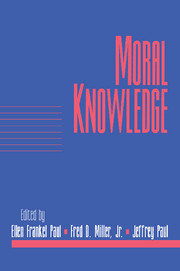

Philosophers since ancient times have pondered how we can know whether moral claims are true or false. The first half of the twentieth century witnessed widespread skepticism concerning the possibility of moral knowledge. Indeed, some argued that moral statements lacked cognitive content altogether, because they were not susceptible to empirical verification. The British philosopher A. J. Ayer contends that 'They are pure expressions of feeling and as such do not come under the category of truth and falsehood. They are unverifiable … because they do not express genuine propositions.' The second half of the twentieth century brought a revival of interest among philosophers in moral and political questions. Whether or not ethics can be founded upon a rational basis continues to preoccupy the philosophical community even now.
Loading metrics...
* Views captured on Cambridge Core between #date#. This data will be updated every 24 hours.
Usage data cannot currently be displayed.
This section outlines the accessibility features of this content - including support for screen readers, full keyboard navigation and high-contrast display options. This may not be relevant for you.
Accessibility compliance for the PDF of this book is currently unknown and may be updated in the future.
