
Skip to main content Accessibility help
×
  • Cited by 3
    • Show more authors
    • Open Access
      You have digital access to this book
    • Select format
    • Publisher:
      Cambridge University Press
      Publication date:
      November 2022
      December 2022
      ISBN:
      9781009082662
      9781316514160
      Creative Commons:
      Creative Common License - CC Creative Common License - BY Creative Common License - NC
      This content is Open Access and distributed under the terms of the Creative Commons Attribution licence CC-BY-NC 4.0.
      https://creativecommons.org/creativelicenses
      Dimensions:
      (229 x 152 mm)
      Weight & Pages:
      0.62kg, 328 Pages
      Dimensions:
      Weight & Pages:
    Open Access
    You have digital access to this book
    Selected: Digital
    View content
    Add to cart View cart Buy from Cambridge.org

    Book description

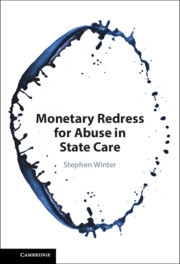
    Investigating a fast-developing field of public policy, Stephen Winter examines how states redress injuries suffered by young people in state care. Considering ten illustrative exemplar programmes from Australia, Canada, Ireland, and Aotearoa New Zealand, Winter explores how redress programmes attempt to resolve the anguish, injustice, and legacies of trauma that survivors experience. Drawing from interviews with key stakeholders and a rich trove of documentary research, this book analyses how policymakers should navigate the trade-offs that survivors face between having their injuries acknowledged and the difficult, often retraumatising, experience of attaining redress. A timely critical engagement with this contentious policy domain, Winter presents empirically driven recommendations and a compelling argument for participatory, flexible, and survivor-focussed programmes. This title is also available as Open Access on Cambridge Core.

    Reviews

    ‘Is justice possible for survivors of child abuse in out-of-home care through monetary redress schemes? In his invaluable analysis of schemes across four nations, Winter identifies how governments should balance political, logistical and ethical values in deciding who should get redress, how much, for what harms, and on what evidence.’

    Frank Golding OAM - Federation University and Vice-President of the Care Leavers Australasia Network.

    ‘Providing unique insight into how redress programmes operate and recommendations for more survivor-focussed responses, this is a must-read for policymakers and those tasked with designing monetary redress schemes.’

    Patricia Lundy - Ulster University.

    ‘This bold and ambitious work succeeds in extracting what does and does not work in redress programmes. Policymakers designing future schemes, survivors, staff at redress boards and researchers will all benefit from Winter’s informative and accessible research.’

    Johanna Sköld - Linköping University.

    ‘This is a thoughtful and illuminating book that deepens our understanding of the problems and promise of monetary redress programmes. Rich in detail, and broad in scope, it is a compelling account of how redress is done, and how programmes for survivors of abuse can be improved.’

    Elizabeth Stanley - Te Herenga Waka - Victoria University of Wellington.

    Refine List

    Actions for selected content:

    Select all | Deselect all
    • View selected items
    • Export citations
    • Download PDF (zip)
    • Save to Kindle
    • Save to Dropbox
    • Save to Google Drive

    Save Search

    You can save your searches here and later view and run them again in "My saved searches".

    Please provide a title, maximum of 40 characters.
    ×

    Contents

    Full book PDF

    Page 1 of 2


    • Monetary Redress for Abuse in State Care
      pp i-ii
    • Frontmatter
      pp i-iv
    • Dedication
      pp v-vi
    • Monetary Redress for Abuse in State Care - Title page
      pp iii-iii
    • Contents
      pp vii-ix
    • Copyright page
      pp iv-iv
    • Dedication
      pp v-vi
    • Tables
      pp x-x
    • Contents
      pp vii-ix
    • Acknowledgements
      pp xi-xii
    • Abbreviations
      pp xiii-xiv
    • Tables
      pp x-x
    • Part I
      pp 1-2
    • Acknowledgements
      pp xi-xii
    • 1 - Introducing Monetary Redress
      pp 3-16
    • 2 - Injurious Histories
      pp 17-30
    • 3 - What Makes Redress Better?
      pp 31-44
    • Abbreviations
      pp xiii-xiv
    • Part II
      pp 45-46
    • 4 - Irish Redress
      pp 47-63
    • 5 - Australian Redress
      pp 64-82
    • 6 - Canadian Redress
      pp 83-104
    • 7 - Redress in Aotearoa New Zealand
      pp 105-116
    • Part I
      pp 1-44
    • Part III
      pp 117-118
    • 1 - Introducing Monetary Redress
      pp 3-16
    • 8 - Redress Policy Design and Delivery
      pp 119-138
    • 2 - Injurious Histories
      pp 17-30
    • 9 - Who and What Should Be Eligible for Redress?
      pp 139-160
    • 3 - What Makes Redress Better?
      pp 31-44

    Page 1 of 2


    Metrics

    Altmetric attention score

    Full text views

    Total number of HTML views: 0
    Total number of PDF views: 0 *
    Loading metrics...

    Book summary page views

    Total views: 0 *
    Loading metrics...

    * Views captured on Cambridge Core between #date#. This data will be updated every 24 hours.

    Usage data cannot currently be displayed.

    Accessibility standard: Unknown

    Why this information is here

    This section outlines the accessibility features of this content - including support for screen readers, full keyboard navigation and high-contrast display options. This may not be relevant for you.

    Accessibility Information

    Accessibility compliance for the PDF of this book is currently unknown and may be updated in the future.
