
Skip to main content Accessibility help
×
  • Cited by 1
    • Show more authors
    • You may already have access via personal or institutional login
    • Select format
    • Publisher:
      Cambridge University Press
      Publication date:
      24 May 2020
      05 August 2021
      ISBN:
      9781108870924
      9781108836425
      Dimensions:
      (228 x 152 mm)
      Weight & Pages:
      0.44kg, 208 Pages
      Dimensions:
      Weight & Pages:
    You may already have access via personal or institutional login
  • Selected: Digital
    Add to cart View cart Buy from Cambridge.org

    Book description

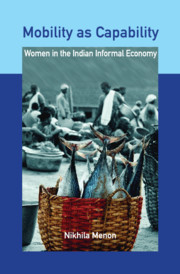
    This book highlights accounts of women workers to capture the domains of gendered mobility, which challenges the exalted status conferred on women in the Kerala model of development. It contests and deconstructs the development discourse which considers women's work mobility as an indicator of autonomy and agency using Capability Approach. The concept of 'transformational mobility' and its measurement introduced in the book advances the understanding of mobility, autonomy and agency and the intersectionality in the context of gender and work. Through an in-depth exploration of lived experiences of informal women workers the author illustrates how patriarchal structures are shaped and reinforced by work places, markets and the state. The central question is - can we steer development policies to facilitate collective capabilities for women where informal work arrangements are becoming the norm?

    Reviews

    'Menon questions prevailing assumptions that women’s mobility, their freedom and ability to move beyond their households into paid work, necessarily enhances their autonomy and empowerment. She draws on Sen’s capability approach to theorize her innovative concept of ‘transformational mobility’ to assess whether women’s work mobility is empowering. Her inter-disciplinary analysis is applied to a fascinating comparison of informal women working in seafood processing versus self-employed fish vendors in Kerala, India. Her findings demonstrate that paid work outside the household is not sufficient to enhance women’s agency and autonomy. Transformational mobility is more likely under circumstances where women have greater collective agency and ability to bargain over their working conditions. Menon’s book is essential reading for all researchers, practitioners and policy makers focusing on women’s work in domestic and global production. It advances an insightful analysis of transformational mobility applicable to assessing a range of occupations. It provides a challenging contribution to current thinking on constraints and potential for women’s social and economic empowerment.'

    Stephanie Barrientos - University of Manchester

    'Menon’s book shatters the myths regarding the exalted status of women in Kerala by drawing attention to the deprivation, segregation in low skilled work, gender gaps in wages and poor working conditions suffered by women engaged in informal work in fisheries. Drawing attention to the constraints imposed on women by patriarchal social structures in Kerala, she questions the prevailing arguments that translate mobility into autonomy and agency. She compares this constrained state with what she calls ‘Transformational mobility’ or freedom in the real sense, a state of non-domination. The pathways to autonomy of women are fraught with several challenges which can be addressed with better understanding of the underlying gender norms, which this book attempts to unravel. The book is a must-read for anyone working in the field of development and gender.'

    Aasha Kapur Mehta - Institute for Human Development, New Delhi

    'The work on Mobility as Capability reflects on a wide range of issues, enhancing our understanding of mobility, autonomy, and agency, and the intersectionality in the context of gender and work. Situating informal work by women in some of the dynamic activities in Kerala the volume envisages women’s work mobility as an indicator of autonomy and agency in terms of capability approach. The work displays commendable originality and innovative thinking, which will stir our reasoning and encourage future research in this direction to help policy initiatives happen in an effective manner.'

    Arup Mitra - Institute of Economic Growth, New Delhi

    Refine List

    Actions for selected content:

    Select all | Deselect all
    • View selected items
    • Export citations
    • Download PDF (zip)
    • Save to Kindle
    • Save to Dropbox
    • Save to Google Drive

    Save Search

    You can save your searches here and later view and run them again in "My saved searches".

    Please provide a title, maximum of 40 characters.
    ×

    Contents

    Metrics

    Altmetric attention score

    Full text views

    Total number of HTML views: 0
    Total number of PDF views: 0 *
    Loading metrics...

    Book summary page views

    Total views: 0 *
    Loading metrics...

    * Views captured on Cambridge Core between #date#. This data will be updated every 24 hours.

    Usage data cannot currently be displayed.

    Accessibility standard: Unknown

    Why this information is here

    This section outlines the accessibility features of this content - including support for screen readers, full keyboard navigation and high-contrast display options. This may not be relevant for you.

    Accessibility Information

    Accessibility compliance for the PDF of this book is currently unknown and may be updated in the future.
