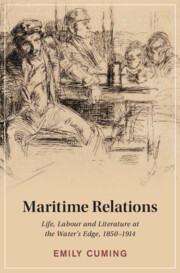

Detailing the lives of ordinary sailors, their families and the role of the sea in Britain's long nineteenth century, Maritime Relations presents a powerful literary history from below. It draws on archival memoirs and logbooks, children's fiction and social surveys, as well as the work of canonical writers such as Gaskell, Dickens, Conrad and Joyce. Maritime Relations highlights the workings of gender, the family, and emotions, with particular attention to the lives of women and girls. The result is an innovative reading of neglected kinship relations that spanned cities and oceans in the Victorian period and beyond. Working at the intersection of literary criticism, the blue humanities and life writing studies, Emily Cuming creatively redefines the relations between life, labour and literature at the waterly edge of the nineteenth century.
Loading metrics...
* Views captured on Cambridge Core between #date#. This data will be updated every 24 hours.
Usage data cannot currently be displayed.
This section outlines the accessibility features of this content - including support for screen readers, full keyboard navigation and high-contrast display options. This may not be relevant for you.
The PDF of this book conforms to version 2.0 of the Web Content Accessibility Guidelines (WCAG), ensuring core accessibility principles are addressed and meets the basic (A) level of WCAG compliance, addressing essential accessibility barriers.
Allows you to navigate directly to chapters, sections, or non‐text items through a linked table of contents, reducing the need for extensive scrolling.
Provides an interactive index, letting you go straight to where a term or subject appears in the text without manual searching.
You will encounter all content (including footnotes, captions, etc.) in a clear, sequential flow, making it easier to follow with assistive tools like screen readers.
You get concise descriptions (for images, charts, or media clips), ensuring you do not miss crucial information when visual or audio elements are not accessible.
You get more than just short alt text: you have comprehensive text equivalents, transcripts, captions, or audio descriptions for substantial non‐text content, which is especially helpful for complex visuals or multimedia.
You gain clarity from ARIA (Accessible Rich Internet Applications) roles and attributes, as they help assistive technologies interpret how each part of the content functions.
