
Skip to main content Accessibility help
×
  • Cited by 53
    • Show more authors
    • You may already have access via personal or institutional login
    • Select format
    • Publisher:
      Cambridge University Press
      Publication date:
      24 April 2020
      14 May 2020
      ISBN:
      9781108784788
      9781108489553
      Dimensions:
      (228 x 152 mm)
      Weight & Pages:
      0.6kg, 292 Pages
      Dimensions:
      Weight & Pages:
    You may already have access via personal or institutional login
  • Selected: Digital
    Add to cart View cart Buy from Cambridge.org

    Book description

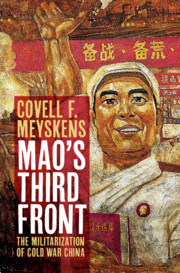
    In 1964, the Chinese Communist Party (CCP) made a momentous policy decision. In response to rising tensions with the United States and Soviet Union, a top-secret massive military industrial complex in the mountains of inland China was built, which the CCP hoped to keep hidden from enemy bombers. Mao named this the Third Front. The Third Front received more government investment than any other developmental initiative of the Mao era, and yet this huge industrial war machine, which saw the mobilization of fifteen million people, was not officially acknowledged for over a decade and a half. Drawing on a rich collection of archival documents, memoirs, and oral interviews, Covell Meyskens provides the first history of the Third Front campaign. He shows how the militarization of Chinese industrialization linked millions of everyday lives to the global Cold War, merging global geopolitics with local change.

    Reviews

    ‘… the Third Front still has potential for further research and this book has laid the groundwork for future efforts.’

    Youngjune Chung Source: Pacific Affairs

    ‘… [offers] both new theoretical insights and methodological innovations to the study of the role of technology in modern Chinese warfare. … [the book] will be inspiration for future studies in the history of warfare and science and technology in modern China.’

    Zhongtian Han Source: China International Strategy Review

    ‘[A] tour de force, agenda-setting monograph that successfully draws out its documentary and oral sources in ways that prompt us to rethink Mao-era regional and industrial history in a wider context of Cold War history. One can only hope that in the future, scholars will be permitted access to sources that can build on this fine piece of scholarship.’

    Julia C. Strauss Source: The China Quarterly

    Refine List

    Actions for selected content:

    Select all | Deselect all
    • View selected items
    • Export citations
    • Download PDF (zip)
    • Save to Kindle
    • Save to Dropbox
    • Save to Google Drive

    Save Search

    You can save your searches here and later view and run them again in "My saved searches".

    Please provide a title, maximum of 40 characters.
    ×

    Contents

    Metrics

    Altmetric attention score

    Full text views

    Total number of HTML views: 0
    Total number of PDF views: 0 *
    Loading metrics...

    Book summary page views

    Total views: 0 *
    Loading metrics...

    * Views captured on Cambridge Core between #date#. This data will be updated every 24 hours.

    Usage data cannot currently be displayed.

    Accessibility standard: Unknown

    Why this information is here

    This section outlines the accessibility features of this content - including support for screen readers, full keyboard navigation and high-contrast display options. This may not be relevant for you.

    Accessibility Information

    Accessibility compliance for the PDF of this book is currently unknown and may be updated in the future.
