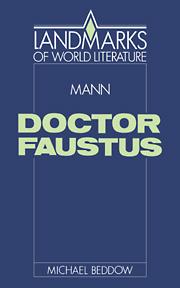

In Doctor Faustus, his last major novel, Thomas Mann attempted to interpret and judge Germany's role in European culture and history since the Reformation. Through the figures of the solitary avant-garde composer, Adrian Leverkühn, and his often bemused biographer Serenus Zeitblom, Mann explores Germany's self-understanding and self-assertion. The novel intermingles fiction and history in a narrative that combines complex psychological analysis, virtuoso stylistic parody and vivid evocation of atmosphere and milieu. Michael Beddow analyses the structure of the plot and explores the significance of its chief historical, theological, psychological and musical themes. He considers Mann's understanding and modification of the Faust tradition, his thematic and formal indebtedness to Nietzsche and his interest in Adorno's neo-Marxism. The study concludes with an account of the work's generally hostile reception in defeated Germany.
Loading metrics...
* Views captured on Cambridge Core between #date#. This data will be updated every 24 hours.
Usage data cannot currently be displayed.
This section outlines the accessibility features of this content - including support for screen readers, full keyboard navigation and high-contrast display options. This may not be relevant for you.
Accessibility compliance for the PDF of this book is currently unknown and may be updated in the future.
