Skip to main content Accessibility help
×
  • Coming soon
  • Show more authors
  • Select format
  • Publisher:
    Cambridge University Press
    ISBN:
    9781009640572
    9781009640534
    Dimensions:
    (229 x 152 mm)
    Weight & Pages:
    300 Pages
    Dimensions:
    Weight & Pages:
Selected: Digital
Add to cart View cart Buy from Cambridge.org

Book description

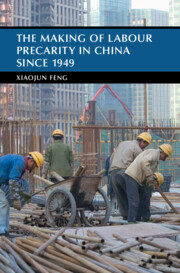
Globally, most workers live precarious lives. In this examination of China's industrial relations since 1949, Xiaojun Feng explores why this should be. China provides an important case to examine this question because it has gone through both socialist revolution and marketized reforms, the major economic and political dynamics that have shaped the world since the twentieth century. Developing a comprehensive analytical framework for the interpretation of archives, interviews, and participant observation, Feng explores the causes of and remedies for labour precarity in China. Bridging the 1949 and 1976 divides, this study unveils continuities and more fundamental discontinuities across these watershed moments, and sheds fresh light on the extent to which popular policy can counter labour precarity and the future dynamics of labour movements.

Reviews

‘The Making of Labour Precarity in China is a tour de force. Feng traces the evolution of precarious labour in urban China over the past century, an era marked by a series of radical changes in employment relations, mastering the complexities of each period.’

Joel Andreas - Johns Hopkins University

‘This is a book of great ambition, executed effectively. Feng shows that worker precarity is not a condition limited to China’s era of marketization, but in fact has emerged in different guises throughout the 20th century. Distinguishing herself from existing studies by unravelling distinct regimes across state socialist and market reform-era China, Feng deepens our understanding not only of China’s labor history, but of how we should think about precarity more generally.’

Eli Friedman - Cornell University

Metrics

Full text views

Total number of HTML views: 0
Total number of PDF views: 0 *
Loading metrics...

Book summary page views

Total views: 0 *
Loading metrics...

* Views captured on Cambridge Core between #date#. This data will be updated every 24 hours.

Usage data cannot currently be displayed.

Accessibility standard: Missing or limited accessibility features

Why this information is here

This section outlines the accessibility features of this content - including support for screen readers, full keyboard navigation and high-contrast display options. This may not be relevant for you.

Accessibility Information

The PDF of this book is known to have missing or limited accessibility features. We may be reviewing its accessibility for future improvement, but final compliance is not yet assured and may be subject to legal exceptions. If you have any questions, please contact accessibility@cambridge.org.

Content Navigation
Table of contents navigation

Allows you to navigate directly to chapters, sections, or non‐text items through a linked table of contents, reducing the need for extensive scrolling.

Index navigation

Provides an interactive index, letting you go straight to where a term or subject appears in the text without manual searching.

Reading Order and Textual Equivalents
Single logical reading order

You will encounter all content (including footnotes, captions, etc.) in a clear, sequential flow, making it easier to follow with assistive tools like screen readers.

Full alternative textual descriptions

You get more than just short alt text: you have comprehensive text equivalents, transcripts, captions, or audio descriptions for substantial non‐text content, which is especially helpful for complex visuals or multimedia.

Visualised data also available as non‐graphical data

You can access graphs or charts in a text or tabular format, so you are not excluded if you cannot process visual displays.

Visual Accessibility
Use of colour is not sole means of conveying information

You will still understand key ideas or prompts without relying solely on colour, which is especially helpful if you have colour vision deficiencies.

Use of high contrast between text and background colour

You benefit from high‐contrast text, which improves legibility if you have low vision or if you are reading in less‐than‐ideal lighting conditions.