Lotteries, Knowledge, and Rational Belief

-
Select format
-
- Publisher:
- Cambridge University Press
- Publication date:
- January 2021
- February 2021
- ISBN:
- 9781108379755
- 9781108421911
- 9781108433051
- Dimensions:
- (228 x 152 mm)
- Weight & Pages:
- 0.556kg, 280 Pages
- Dimensions:
- (229 x 152 mm)
- Weight & Pages:
- 0.4kg, 280 Pages
- Subjects:
- Epistemology and Metaphysics, Logic, Philosophy
You may already have access via personal or institutional login- Subjects:
- Epistemology and Metaphysics, Logic, Philosophy
Show more authors 
You may already have access via personal or institutional login
Book description
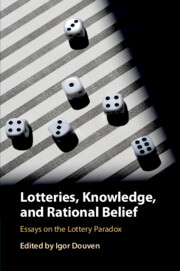
We talk and think about our beliefs both in a categorical (yes/no) and in a graded way. How do the two kinds of belief hang together? The most straightforward answer is that we believe something categorically if we believe it to a high enough degree. But this seemingly obvious, near-platitudinous claim is known to give rise to a paradox commonly known as the 'lottery paradox' – at least when it is coupled with some further seeming near-platitudes about belief. How to resolve that paradox has been a matter of intense philosophical debate for over fifty years. This volume offers a collection of newly commissioned essays on the subject, all of which provide compelling reasons for rethinking many of the fundamentals of the debate.
Contents
Contents
References
Metrics
Full text views
Full text views helpTotal number of HTML views: 0
Total number of PDF views: 0 *
 Loading metrics...
* Views captured on Cambridge Core between #date#. This data will be updated every 24 hours.
Usage data cannot currently be displayed.
Accessibility standard: Unknown
Why this information is here
This section outlines the accessibility features of this content - including support for screen readers, full keyboard navigation and high-contrast display options. This may not be relevant for you.
Accessibility Information
Accessibility compliance for the PDF of this book is currently unknown and may be updated in the future.