
Skip to main content Accessibility help
×
  • Cited by 3
    • Show more authors
    • You may already have access via personal or institutional login
    • Select format
    • Publisher:
      Cambridge University Press
      Publication date:
      07 May 2024
      24 October 2024
      ISBN:
      9781108781039
      9781108490481
      9781009525244
      Dimensions:
      (228 x 152 mm)
      Weight & Pages:
      0.79kg, 280 Pages
      Dimensions:
      (228 x 150 mm)
      Weight & Pages:
      0.65kg, 280 Pages
    You may already have access via personal or institutional login
  • Selected: Digital
    Add to cart View cart Buy from Cambridge.org

    Book description

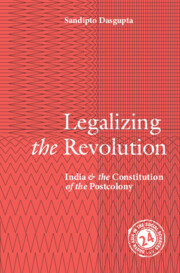
    Anticolonial movements of the twentieth century generated ambitious ideas of freedom. Following decolonization, the challenge was to give an institutional form to those ideas. Through an original account of India's constitution making, Legalizing the Revolution explores the promises, challenges, and contradictions of that task. In contrast to derived templates, Dasgupta theorizes the distinctively postcolonial constitution through an innovative synthesis of the history of decolonization and constitutional theory. The book traces the contentious transition from the tumult of popular anticolonial politics to the ordered calculus of postcolonial governance; and then explains how major institutions – parliament, judiciary, rights, property – were formed by that foundational tension. A major contribution to postcolonial political theory, the book excavates the unrealized futures of decolonization. At the same time, through a critical account of the making of the postcolonial constitutional order, it offers keys to understanding the present crisis of that order, including and especially in India.

    Awards

    Winner, 2025 South Asian Politics Section 55 Francine Frankel Award, American Political Science Association

    Winner, 2025 ICONS Annual Book Prize, International Society for Public Law

    Reviews

    ‘In this important contribution to political and constitutional theory, Sandipto Dasgupta tracks the distinctive character and logic of the postcolonial constitution. Rather than closing a revolution, constitutions in the decolonizing world were designed to facilitate the revolution to come. Examining the antinomies of this ‘transformational constitutionalism’ to prompt a wider reconsideration of the ends of constitutionalism, Legalizing the Revolution models postcolonial political theory at its best.’

    Adom Getachew - University of Chicago

    ‘In this remarkable new study, Sandipto Dasgupta offers a fascinating examination of a great paradox of modern history: how in the process of decolonization, a revolution - the activity maximally opposed to legal order - seeks to produce, out of itself, a constitution, the primary device for the creation of an expansive, stable legal system. The argument of the book joins together two strands of analysis rarely brought together: the tumultuous history of the events of decolonization and the tranquil discussion of provisions of effective legality. It follows the acts of the double authors of the constitutional document: the people in whose name it is written and the actual writers who shape its detailed provisions. This is an intelligent and insightful exploration of the founding moment of the world’s largest democracy - an important contribution to the political theory of decolonization.’

    Sudipta Kaviraj - Columbia University

    ‘This account of the origins of the Indian constitution is nothing short of heroic, and its relevance to our global present is plain. Arrestingly, Sandipto Dasgupta lifts promotional and romanticizing frames - however appealing in the face of far-right politics today - in order to recapture the promise of postcolonial democracy without ignoring imperial legacies of constitutionalism itself and material realities that elite legalism confirmed as much as challenged. Lurking beneath contemporary appropriations that excessively centre rights and judges rather than class and parliamentarism, Dasgupta provides authentic access to the stakes of the moment - and our own.’

    Samuel Moyn - Yale University

    Refine List

    Actions for selected content:

    Select all | Deselect all
    • View selected items
    • Export citations
    • Download PDF (zip)
    • Save to Kindle
    • Save to Dropbox
    • Save to Google Drive

    Save Search

    You can save your searches here and later view and run them again in "My saved searches".

    Please provide a title, maximum of 40 characters.
    ×

    Contents

    Metrics

    Altmetric attention score

    Full text views

    Total number of HTML views: 0
    Total number of PDF views: 0 *
    Loading metrics...

    Book summary page views

    Total views: 0 *
    Loading metrics...

    * Views captured on Cambridge Core between #date#. This data will be updated every 24 hours.

    Usage data cannot currently be displayed.

    Accessibility standard: Unknown

    Why this information is here

    This section outlines the accessibility features of this content - including support for screen readers, full keyboard navigation and high-contrast display options. This may not be relevant for you.

    Accessibility Information

    Accessibility compliance for the PDF of this book is currently unknown and may be updated in the future.
