Metrics
Full text views
Full text views help
Loading metrics...
* Views captured on Cambridge Core between #date#. This data will be updated every 24 hours.
Usage data cannot currently be displayed.
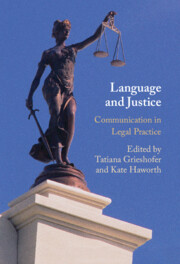
Bringing together cutting-edge research at the intersection of language, communication and legal practice, this volume challenges established processes and explores key questions arising from real cases, practices, or sites of contention, where tackling linguistic issues can help enhance access to justice. Directly addressing areas of genuine professional and institutional concern, the collection provides novel and groundbreaking insights into the multiple communication-related challenges the justice system and legal professionals have to navigate on a daily basis. The volume engages with a wide range of legal areas, including criminal law, family law, civil law, immigration, international law, and legal education. It has an international scope, with relevance across both adversarial and inquisitorial legal systems, international legal institutions, and multilingual jurisdictions. Collectively, the chapters highlight the immense benefits and opportunities which arise when legal and applied linguistic scholarship are harnessed together, especially for scrutinising the accountability, transparency and accessibility of the justice system.
Loading metrics...
* Views captured on Cambridge Core between #date#. This data will be updated every 24 hours.
Usage data cannot currently be displayed.
This section outlines the accessibility features of this content - including support for screen readers, full keyboard navigation and high-contrast display options. This may not be relevant for you.
Accessibility compliance for the PDF of this book is currently unknown and may be updated in the future.
