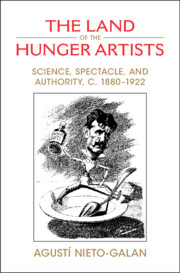
The Land of the Hunger Artists

-
Select format
-
- Publisher:
- Cambridge University Press
- Publication date:
- November 2023
- November 2023
- ISBN:
- 9781009379540
- 9781009379588
- 9781009379564
- Dimensions:
- (229 x 152 mm)
- Weight & Pages:
- 0.59kg, 282 Pages
- Dimensions:
- (229 x 152 mm)
- Weight & Pages:
- 0.42kg, 282 Pages
You may already have access via personal or institutional login
Show more authors 
You may already have access via personal or institutional login
Book description
From the 1880s to the 1920s, hunger artists - professional fasters - lived on the fringes of public spectacle and academic experiment. Agustí Nieto-Galan presents the history of this phenomenon as popular urban spectacle and subject of scientific study, showing how hunger artists acted as mediators between the human and the social body. Doctors, journalists, impresarios , artists, and others used them to reinforce their different philosophical views, scientific schools, political ideologies, cultural values, and professional interests. The hunger artists generated heated debates on objectivity and medical pluralism, and fierce struggles over authority, recognition, and prestige. Set on the fringes of the freak show culture of the nineteenth century and the scientific study of physiology laboratories, Nieto-Galan explores the story of the public exhibition of hunger, emaciated bodies, and their enormous impact on the public sphere of their time.
Awards
Long-listed, 2024 John Pickstone Prize, The British Society for the History of Science
Reviews
‘Agustí Nieto-Galan’s book offers the first in-depth and scholarly account of the hunger artists of Italy after unification. Drawing on the rich body of texts, images, and goods that marked the spectacular fasts of these individuals on their global trajectories, he skillfully balances the perspectives of rapt publics, doubting doctors, enthusiastic impresarios, and an expanding media culture. Diverse groups of commentators contended over the veracity or fraudulence of the capabilities of their extraordinary bodies, as well as over what profits could be made out of them. In a period that gave rise to most of our modern categories of food requirements and eating disorders, these men came to exemplify both the limits and the potential of nutrition science, both inside and outside the laboratory. A fascinating book that stands at the intersection of many areas of historical interest.’
Emma Spary - University of Cambridge
‘In this engaging study of hunger artists in late nineteenth-century Europe, Nieto-Galan pushes the history of hunger in new directions. Were hunger artists freaks of nature, charlatans looking for easy gain, fruitful subjects for medical research, or savvy entertainers? By examining contemporary debates, Nieto-Galan shows how these artists shaped scientific and popular understandings of hunger while simultaneously updating the performative aspects of hunger for the modern world.’
Corinna Treitel - Professor and Chair, Department of History, Washington University in St Louis
‘An impressively broad and generative examination of its complicated and colourful topic, The Land of the Hunger Artists provides an insightful plunge into the intersections between science, entertainment and Victorian culture, as well as offering a deeply captivating read for those curious.’
David Ben Hall Source: Performance Research
‘… the sheer weight of commentary on the hunger artist - by onlookers, experts, fiction writers, fasters themselves - suggests that the author is right to link this material to powerful sociocultural trends. As he convincingly shows, the hunger artist exemplifies a dramatic shift from the religious to the secular body; from a confident materialist science to one that, when turning to human subjects, was often ambivalent and uncertain; and from local to global connections in science, commerce, and entertainment. These insights constitute an impressive achievement, even if, as the author concludes, the hunger artist will still demand 'future historical analysis'.’
Elizabeth A. Williams Source: Journal of Modern History
Contents
Contents
References
Metrics
Altmetric attention score
Full text views
Full text views helpTotal number of HTML views: 0
Total number of PDF views: 0 *
 Loading metrics...
* Views captured on Cambridge Core between #date#. This data will be updated every 24 hours.
Usage data cannot currently be displayed.
Accessibility standard: Unknown
Why this information is here
This section outlines the accessibility features of this content - including support for screen readers, full keyboard navigation and high-contrast display options. This may not be relevant for you.
Accessibility Information
Accessibility compliance for the PDF of this book is currently unknown and may be updated in the future.