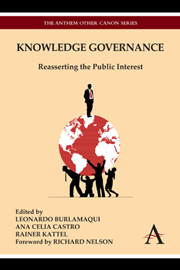

This book argues that the current international intellectual property rights regime, led by the World Trade Organization (WTO), has evolved over the past three decades toward overemphasizing private interests and seriously hampering public interests in access to knowledge and innovation diffusion. This approach concentrates on tangible and codified knowledge creation and diffusion in research and development (R&D) that can be protected via patents and other intellectual property rules and regulations. In terms of global policy initiatives, however, it is becoming increasingly clear that the WTO in particular is mostly a conflict-resolution facility rather than a global governance body able to generate cooperation and steer international coordinated policy action. At the same time, rent extraction and profits streaming from legal hyperprotection have become pervasively important for firm strategies to compete in a globalized marketplace. “Knowledge Governance: Reasserting the Public Interest” offers a novel approach – knowledge governance – in order to move beyond the current regime.
Loading metrics...
* Views captured on Cambridge Core between #date#. This data will be updated every 24 hours.
Usage data cannot currently be displayed.
This section outlines the accessibility features of this content - including support for screen readers, full keyboard navigation and high-contrast display options. This may not be relevant for you.
Accessibility compliance for the PDF of this book is currently unknown and may be updated in the future.
