
Skip to main content Accessibility help
×
  • Cited by 52
    • Show more authors
    • Open Access
      You have digital access to this book
    • Select format
    • Publisher:
      Cambridge University Press
      Publication date:
      07 January 2021
      21 January 2021
      ISBN:
      9781108863575
      9781108495905
      9781108811026
      Creative Commons:
      Creative Common License - CC Creative Common License - BY Creative Common License - NC Creative Common License - ND
      This content is Open Access and distributed under the terms of the Creative Commons Attribution licence CC-BY-NC-ND 4.0.
      https://creativecommons.org/creativelicenses
      Dimensions:
      (229 x 152 mm)
      Weight & Pages:
      0.62kg, 332 Pages
      Dimensions:
      (229 x 152 mm)
      Weight & Pages:
      0.49kg, 332 Pages
    Open Access
    You have digital access to this book
    Selected: Digital
    View content
    Add to cart View cart Buy from Cambridge.org

    Book description

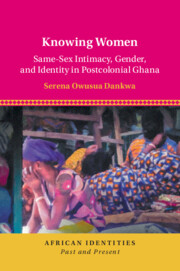
    Knowing Women is a study of same-sex desire in West Africa, which explores the lives and friendships of working-class women in southern Ghana who are intimately involved with each other. Based on in-depth research of the life histories of women in the region, Serena O. Dankwa highlights the vibrancy of everyday same-sex intimacies that have not been captured in a globally pervasive language of sexual identity. Paying close attention to the women's practices of self-reference, Dankwa refers to them as 'knowing women' in a way that both distinguishes them from, and relates them to categories such as lesbian or supi, a Ghanaian term for female friend. In doing so, this study is not only a significant contribution to the field of global queer studies in which both women and Africa have been underrepresented, but a starting point to further theorize the relation between gender, kinship, and sexuality that is key to queer, feminist, and postcolonial theories. This title is also available as Open Access on Cambridge Core.

    Awards

    Finalist, 2022 Best Book Award, African Studies Association

    Winner, 2022 Ruth Benedict Book Prize, Outstanding Single Authored Monograph, The Association for Queer Anthology

    Winner, 2022 Choice Outstanding Academic Titles

    Reviews

    ‘This remarkable book deserves a wide audience … Theoretically subtle and accessible and beautifully written … Highly recommended.’

    C. Higgs Source: Choice Magazine

    ‘The book’s rich ethnographic account adds to the life accounts of queer Africans emerging in the form of memoirs, autobiographical accounts, and documentaries. Also, the book centers the unruliness of sexuality outside how it has been constructed historically by religion and medicine. The five-chapter book, with an introduction and conclusion, uses a multidisciplinary approach that emphasizes friendship rather than sexuality to trouble ideas of gender, kinship, and same-sex desire in Ghana while accounting for ways that they overlap and detour from those of Europe and North America.’

    Rosemary Oyinlola Popoola Source: PoLAR: Political and Legal Anthropology Review

    Refine List

    Actions for selected content:

    Select all | Deselect all
    • View selected items
    • Export citations
    • Download PDF (zip)
    • Save to Kindle
    • Save to Dropbox
    • Save to Google Drive

    Save Search

    You can save your searches here and later view and run them again in "My saved searches".

    Please provide a title, maximum of 40 characters.
    ×

    Contents

    Full book PDF
    • Knowing Women
      pp i-i
    • African Identities: Past and Present - Series page
      pp ii-ii
    • Knowing Women - Title page
      pp iii-iii
    • Same-Sex Intimacy, Gender, and Identity in Postcolonial Ghana
    • Copyright page
      pp iv-iv
    • Dedication
      pp v-vi
    • Contents
      pp vii-vii
    • Figures
      pp viii-viii
    • Acknowledgments
      pp ix-xii
    • Prologue: Arrival Stories
      pp 1-17
    • Introduction: Freeing Our Imaginations
      pp 18-46
    • 1 - Tacit Erotic Intimacies and the Culture of Indirection
      pp 47-78
    • 2 - Supi, Secrecy, and the Gift of Knowing
      pp 79-122
    • 3 - “The One Who First Says ‘I Love You’”
      pp 123-171
    • Ɔbaa Barima, Gender, and Erotic Subjectivity
    • 4 - Sugar Motherhood and the Collectivization of Love
      pp 172-219
    • 5 - “Doing Everything Together”
      pp 220-266
    • Siblinghood, Lovership, Incest, Family
    • Conclusion: A Fabric that Never Goes Out of Fashion
      pp 267-279
    • Bibliography
      pp 280-302
    • Index
      pp 303-318

    Metrics

    Altmetric attention score

    Full text views

    Total number of HTML views: 0
    Total number of PDF views: 0 *
    Loading metrics...

    Book summary page views

    Total views: 0 *
    Loading metrics...

    * Views captured on Cambridge Core between #date#. This data will be updated every 24 hours.

    Usage data cannot currently be displayed.

    Accessibility standard: Unknown

    Why this information is here

    This section outlines the accessibility features of this content - including support for screen readers, full keyboard navigation and high-contrast display options. This may not be relevant for you.

    Accessibility Information

    Accessibility compliance for the PDF of this book is currently unknown and may be updated in the future.
