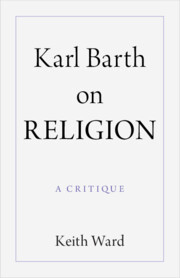
Karl Barth on Religion

-
Select format
-
- Publisher:
- Cambridge University Press
- Publication date:
- 14 November 2024
- 21 November 2024
- ISBN:
- 9781009555456
- 9781009555432
- 9781009555418
- Dimensions:
- (216 x 140 mm)
- Weight & Pages:
- 0.37kg, 204 Pages
- Dimensions:
- (216 x 140 mm)
- Weight & Pages:
- 0.27kg, 204 Pages
- Subjects:
- History of Religion, Religion, Theology
You may already have access via personal or institutional login- Subjects:
- History of Religion, Religion, Theology
Show more authors 
You may already have access via personal or institutional login
Book description
Karl Barth is one of the most influential theologians of the past century, especially within conservative branches of Christianity. Liberals, by contrast, find many of his ideas to be problematic. In this study, Keith Ward offers a detailed critique of Barth's views on religion and revelation as articulated in Church Dogmatics. Against Barth's definition of religions as self-centred, wilful, and arbitrary human constructions, Ward offers a defence of world religions as a God-inspired search for and insight into spiritual truth. Questioning Barth's rejection of natural theology and metaphysics, he provides a defence of the necessity of a philosophical foundation for Christian faith. Ward also dismisses Barth's biased summaries of German liberal thought, upholding a theological liberalism that incorporates Enlightenment ideas of critical inquiry and universal human rights that also retains beliefs that are central to Christianity. Ward defends the universality of divine grace against Barth's apparent denial of it to non-Christian religions.
Reviews
‘The text itself is very well written and provides insight into Ward’s own Anglican theology in tension with Barth’s Evangelical Protestant theology. While not written for Barth scholars, this text would provide a useful counterpoint to Barth in a course on 20th-century Christian theology. It would also be valuable for Christian pastors to think carefully about religion, revelation, and justification as they are presented to congregations … Recommended.’
V. M. Ehret Source: Choice
Contents
Contents
References
Metrics
Altmetric attention score
Full text views
Full text views helpTotal number of HTML views: 0
Total number of PDF views: 0 *
 Loading metrics...
* Views captured on Cambridge Core between #date#. This data will be updated every 24 hours.
Usage data cannot currently be displayed.
Accessibility standard: Unknown
Why this information is here
This section outlines the accessibility features of this content - including support for screen readers, full keyboard navigation and high-contrast display options. This may not be relevant for you.
Accessibility Information
Accessibility compliance for the PDF of this book is currently unknown and may be updated in the future.