
Skip to main content Accessibility help
×
  • Cited by 5
    • Show more authors
    • You may already have access via personal or institutional login
    • Select format
    • Publisher:
      Cambridge University Press
      Publication date:
      25 July 2024
      25 July 2024
      ISBN:
      9781009385428
      9781009385435
      Dimensions:
      (229 x 152 mm)
      Weight & Pages:
      0.493kg, 261 Pages
      Dimensions:
      Weight & Pages:
    You may already have access via personal or institutional login
  • Selected: Digital
    Add to cart View cart Buy from Cambridge.org

    Book description

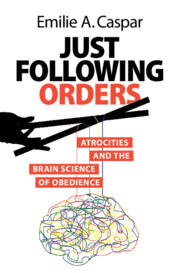
    How can obedience and carrying out orders lead to horrific acts such as the Holocaust or the genocides in Rwanda, Cambodia, or Bosnia? For the most part, it is a mystery why obeying instructions from an authority can convince people to kill other human beings, sometimes without hesitation and with incredible cruelty. Combining social and cognitive neuroscience with real-life accounts from genocide perpetrators, this book sheds light on the process through which obedience influences cognition and behavior. Emilie Caspar, a leading expert in the field, translates this neuroscientific approach into a clear, uncomplicated explanation, even for those with no background in psychology or neuroscience. By better understanding humanity's propensity for direct orders to short-circuit our own independent decision-making, we can edge closer to effective prevention processes.

    Reviews

    'The reason sentient human beings are able to commit atrocities they recognise as such is that direct orders circumvent individual decision-making. This mental quirk, says the neuroscientist Emilie A Caspar, is why genocide - from the Holocaust to Rwanda - happens. Her book is a lucid study of the 'brain science' of obedience and its consequences.'

    Source: New Statesman

    ‘Emilie Caspar’s book resurrects Milgram’s agentic shift theory of obedience. Combining the results of laboratory studies with interviews with participants in the mass killings in Cambodia in the 1970s and Rwanda in 1994, Caspar argues that we should believe perpetrators who say they were just following orders. Her interviewees often explain themselves with versions of this claim. Participants in her new shock-giving obedience experiments often say the same. And brain recordings from these participants - based on functional magnetic resonance imaging (fMRI) studies - show different patterns for ordered and for free choice shock giving - suggesting that participants are in a different state when acting under orders.’

    Clark McCauley Source: Lawfare

    Refine List

    Actions for selected content:

    Select all | Deselect all
    • View selected items
    • Export citations
    • Download PDF (zip)
    • Save to Kindle
    • Save to Dropbox
    • Save to Google Drive

    Save Search

    You can save your searches here and later view and run them again in "My saved searches".

    Please provide a title, maximum of 40 characters.
    ×

    Contents

    Metrics

    Altmetric attention score

    Full text views

    Total number of HTML views: 0
    Total number of PDF views: 0 *
    Loading metrics...

    Book summary page views

    Total views: 0 *
    Loading metrics...

    * Views captured on Cambridge Core between #date#. This data will be updated every 24 hours.

    Usage data cannot currently be displayed.

    Accessibility standard: Unknown

    Why this information is here

    This section outlines the accessibility features of this content - including support for screen readers, full keyboard navigation and high-contrast display options. This may not be relevant for you.

    Accessibility Information

    Accessibility compliance for the PDF of this book is currently unknown and may be updated in the future.
