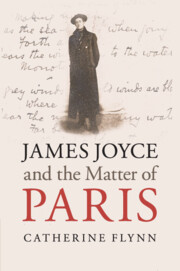

In James Joyce and the Matter of Paris, Catherine Flynn recovers the paradigmatic city of European urban modernity as the foundational context of Joyce's imaginative consciousness. Beginning with Joyce's underexamined first exile in 1902–03, she shows the significance for his writing of the time he spent in Paris and of a range of French authors whose works inflected his experience of that city. In response to the pressures of Parisian consumer capitalism, Joyce drew on French literature to conceive a somatic aesthetic, in which the philosophically disparaged senses of taste, touch, and smell as well as the porous, digestive body resist capitalism's efforts to manage and instrumentalize desire. This book resituates the most canonical of Irish modernists in a European avant-garde context while revealing important links between Anglophone modernism and critical theory.
'This strikingly original book advances several interrelated arguments about the importance of Paris for understanding Joyce's work. Flynn shows that for Joyce, Paris embodied the spectacle, and the challenges, of the modern city and its burgeoning consumer capitalism. She argues that Joyce responded to Paris by imagining new ways of thinking through the senses, the body, and materiality generally. This 'sentient thinking', as Flynn articulates it, is both an innovative model of subjectivity and the formulation of an embodied aesthetic. James Joyce and the Matter of Paris departs from the dominant scholarly trends of the last two decades and promises to reshape scholarship on Joyce, modernism, and aesthetics decisively.'
Marjorie Howes - Boston College
'James Joyce and the Matter of Paris changes our sense of Joyce’s entire trajectory. Flynn’s eloquent and original book demonstrates that Paris was for Joyce more than a place to publish and flourish, more than a theme in his texts, it was a style, a way of writing, of thinking and of feeling. Thanks to this compelling study of the impact of a French poetic sensibility on Joyce, we discover a more capacious and politicized author immersed in a modernité conceptualized by Walter Benjamin.'
Jean-Michel Rabaté - University of Pennsylvania
'Catherine Flynn gives us the first comprehensive guide not to Joyce’s Paris, but rather to Paris’s Joyce: how the city, and the artistic, economic, and cultural landscape he encountered there fundamentally shaped the writer’s vision. This book, for the first time, shows us how Paris is the second city of the Joycean imagination.'
Barry McCrea - University of Notre Dame, Indiana
'This book presents evidence of Joyce’s development that has the authority of a documentary chronicle. With intellectual and critical intelligence of exceptional discernment, Catherine Flynn has given us a field-altering account of Joyce’s literary career and its establishing circumstances. James Joyce and the Matter of Paris will be indispensable for Joyce studies as well as for scholars of modernism.'
Vincent Sherry - Washington University, St Louis
Loading metrics...
* Views captured on Cambridge Core between #date#. This data will be updated every 24 hours.
Usage data cannot currently be displayed.
This section outlines the accessibility features of this content - including support for screen readers, full keyboard navigation and high-contrast display options. This may not be relevant for you.
Accessibility compliance for the PDF of this book is currently unknown and may be updated in the future.
