
Skip to main content Accessibility help
×
  • Cited by 14
    • Show more authors
    • You may already have access via personal or institutional login
    • Select format
    • Publisher:
      Cambridge University Press
      Publication date:
      March 2021
      March 2021
      ISBN:
      9781108951371
      9781108845250
      9781108949965
      Dimensions:
      (229 x 152 mm)
      Weight & Pages:
      0.481kg, 224 Pages
      Dimensions:
      (229 x 152 mm)
      Weight & Pages:
      0.331kg, 222 Pages
    You may already have access via personal or institutional login
  • Selected: Digital
    Add to cart View cart Buy from Cambridge.org

    Book description

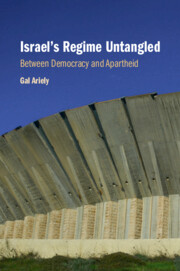
    Israel attracts enormous attention among scholars, journalists, politicians, and the general public. Some regard the country as an apartheid regime that can only be challenged through boycotts and sanctions. Others believe it is a stable liberal democracy, created under extreme conditions. This book seeks to unravel these conflicting interpretations by focusing on three questions: How can the Israeli regime be classified? What are the borders of the Israeli regime? And what are the key factors that shape the regime and support its relative stability? Gal Ariely calls for an approach which disaggregates democracy into specific dimensions, examining the diverse aspects of the Israeli regime to determine the level of 'democraticness' exhibited rather than classifying the regime as a whole. In doing so he provides a comprehensive account of the Israeli regime, untangling conflicting interpretations and illustrates the advantages of using this approach for analysing disputed regimes more widely.

    Reviews

    ‘Ariely introduces an original and variegated approach in his systematic classification of the Israeli regime. He very effectively explains how the ability of the state to strike a balance between different levels of democratic and non-democratic administrative and institutional tools, in various zones of control enable the regime to maintain its stability, despite its many contradictions.’

    Amal Jamal - Tel-Aviv University

    ‘Is Israel a democracy? Gal Ariely approaches this fraught question from a novel perspective, telling us that it depends on where you look - which of Israel’s disputed borders you choose and on which dimensions of democracy you focus. This meticulously researched and carefully analyzed book is an eye-opener, offering an innovative way of thinking about democracy.’

    Joel S. Migdal - University of Washington and Hebrew University of Jerusalem

    ‘This is a timely and innovative book. It contributes to both the literature on democracies and Israel. Relying on his vast theoretical knowledge and research experience, Gal Ariely defuses the charged rhetoric about the Israeli regime and presents the reader with a dispassionate, nuanced, and clear picture.’

    Ami Pedahzur - University of Texas, Austin

    Refine List

    Actions for selected content:

    Select all | Deselect all
    • View selected items
    • Export citations
    • Download PDF (zip)
    • Save to Kindle
    • Save to Dropbox
    • Save to Google Drive

    Save Search

    You can save your searches here and later view and run them again in "My saved searches".

    Please provide a title, maximum of 40 characters.
    ×

    Contents

    Metrics

    Altmetric attention score

    Full text views

    Total number of HTML views: 0
    Total number of PDF views: 0 *
    Loading metrics...

    Book summary page views

    Total views: 0 *
    Loading metrics...

    * Views captured on Cambridge Core between #date#. This data will be updated every 24 hours.

    Usage data cannot currently be displayed.

    Accessibility standard: Unknown

    Why this information is here

    This section outlines the accessibility features of this content - including support for screen readers, full keyboard navigation and high-contrast display options. This may not be relevant for you.

    Accessibility Information

    Accessibility compliance for the PDF of this book is currently unknown and may be updated in the future.
